
In a supermarket, “sweetener” can mean very different things. Table sugar, sugar-free gum and a zero-calorie drink all taste sweet, yet they get there in three different ways.
In short, there are three families: sugars, sugar alcohols (polyols) and high-intensity sweeteners. The last group includes both synthetic and plant-derived options. Each one is regulated, and in each case safety comes down to how much you eat compared with the acceptable daily intake (ADI), the amount considered safe to consume every day across a lifetime. This guide explains each family, how they work, where they turn up, and how regulators and myths fit in.
Key Takeaways
- There are three main families: sugars, sugar alcohols (polyols) and high-intensity sweeteners, which can be synthetic or plant-derived (EFSA; FDA).
- High-intensity sweeteners are roughly 200 to 20,000 times sweeter than sugar, so only milligram amounts are needed (FDA).
- Regulators set an ADI for each one. EFSA’s ADI for acesulfame K is 15 mg per kg of body weight per day (EFSA, 2025).
- Bodies do not always agree: the sucralose ADI is 15 for EFSA and 5 for the US FDA (EFSA, 2026; FDA).
- WHO’s 2023 guideline conditionally advises against non-sugar sweeteners for weight control, and its 2015 guideline advises keeping free sugars below 10% of energy (WHO, 2023; WHO, 2015).
What are the main types of sweeteners?
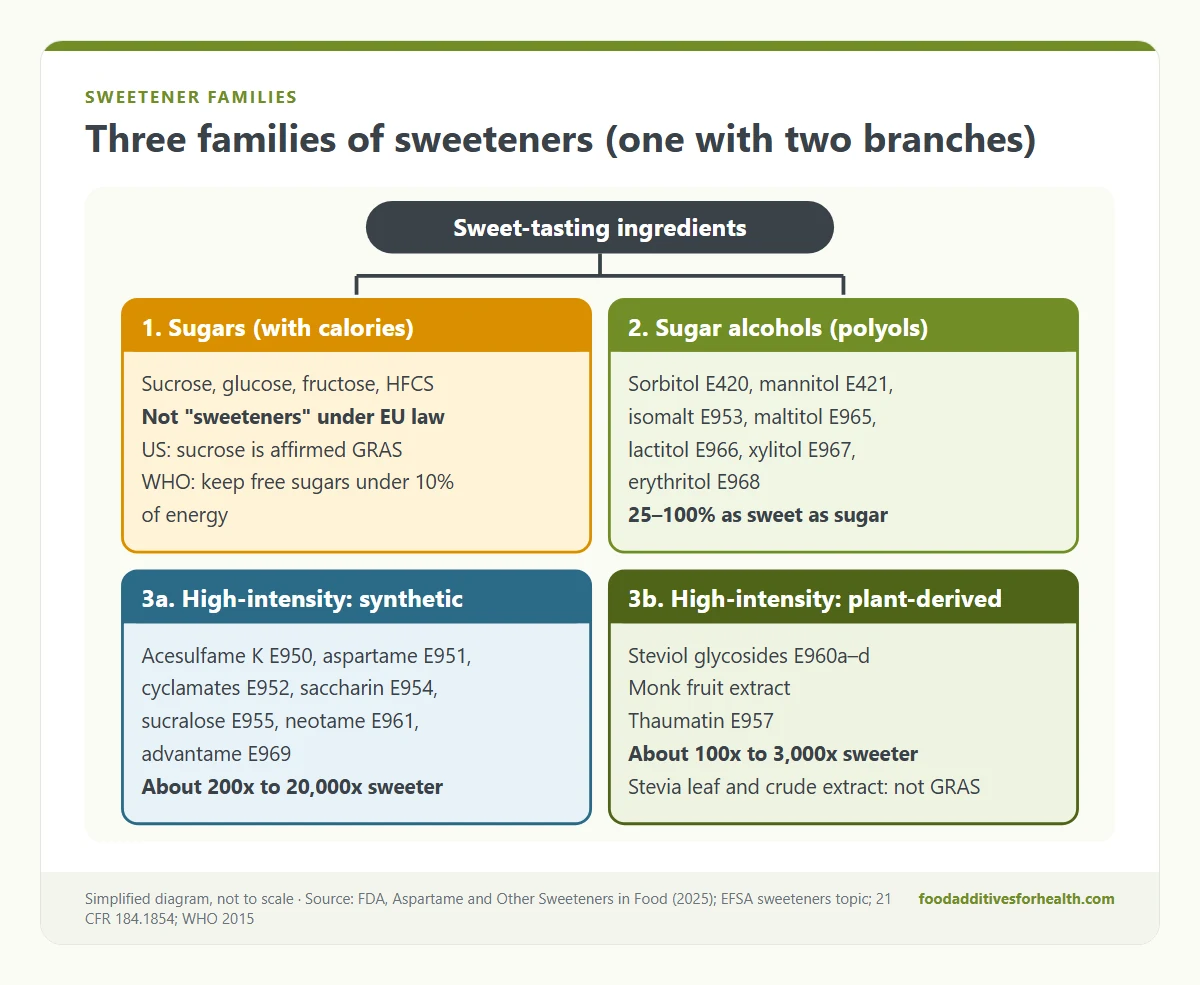
Sweeteners fall into three main families. Sugars (such as sucrose, glucose and fructose) provide energy. Sugar alcohols (polyols such as sorbitol, xylitol and erythritol) are 25 to 100% as sweet as sugar and still contain calories. High-intensity sweeteners (such as aspartame, sucralose, stevia extracts and monk fruit extract) are so sweet that tiny amounts are enough.
Sugars (nutritive sweeteners)
These are the sweeteners most people grew up with: sucrose (table sugar), glucose, fructose and syrups such as high-fructose corn syrup. They are “nutritive” because the body uses them for energy. One legal quirk is worth knowing. Under EU law they are not counted as “sweeteners” at all, because mono-, di- and oligosaccharides (single, double and short-chain sugar molecules) are excluded from that additive category (EFSA). In the US, sucrose is affirmed as generally recognised as safe, or GRAS (21 CFR 184.1854).
Sugar alcohols (polyols)
Despite the name, sugar alcohols are neither sugar nor alcohol in the drinks sense. They are a separate group of carbohydrates whose names usually end in “-itol”. The FDA describes them as 25 to 100% as sweet as sugar, and says they do not promote tooth decay or cause a sudden increase in blood glucose (FDA). The EU list includes sorbitol (E420), mannitol (E421), isomalt (E953), maltitol (E965), lactitol (E966), xylitol (E967) and erythritol (E968) (EFSA). They still contain calories, which is why WHO does not count them as non-sugar sweeteners (WHO, 2023).
High-intensity sweeteners
This family has two branches.
Synthetic: acesulfame K (E950), aspartame (E951), cyclamates (E952), saccharin (E954), sucralose (E955), neotame (E961), aspartame-acesulfame salt (E962) and advantame (E969) (EFSA). The FDA lists aspartame at about 200 times sweeter than sugar, sucralose about 600 times, saccharin 200 to 700 times, neotame 7,000 to 13,000 times and advantame about 20,000 times (FDA).
Plant-derived: steviol glycosides (E960a–d, the sweet compounds from the stevia plant), monk fruit extract (from Siraitia grosvenorii) and thaumatin (E957, a sweet protein). The FDA gives high-purity steviol glycosides as 200 to 400 times sweeter than sugar, monk fruit 100 to 250 times and thaumatin 2,000 to 3,000 times. It also notes that stevia leaf and crude stevia extracts are not considered GRAS (FDA).
“Plant-derived” does not put a sweetener in a different policy category. WHO’s definition of non-sugar sweeteners covers synthetic, naturally occurring and modified ones, including stevia derivatives (WHO, 2023).
| Type | Examples (E-number) | Sweetness vs sugar | Calories |
|---|---|---|---|
| Sugars | Sucrose, glucose, fructose, HFCS | Reference point | Provide energy |
| Sugar alcohols | Sorbitol E420, xylitol E967, erythritol E968 | 25–100% (FDA) | Contain calories (WHO, 2023) |
| High-intensity, synthetic | Aspartame E951, sucralose E955 | About 200x to 20,000x (FDA) | Negligible at milligram doses |
| High-intensity, plant-derived | Steviol glycosides E960, monk fruit extract | About 100x to 3,000x (FDA) | Negligible at milligram doses |
How sweeteners work
Sweetness begins on the tongue. Taste cells carry a two-part receptor called T1R2/T1R3 (a protein that sits in the cell membrane and signals the brain when a sweet molecule attaches to it). Sugars, sucralose, aspartame, stevia compounds and cyclamate all activate it, but they appear to bind at different spots, which helps explain their different potencies and why some blends taste sweeter together than apart (Mechanisms for Sweetness; The Functional Role of the T1R Family of Receptors in Sweet Taste and Feeding). The exact binding sites are still debated, so treat that as a general picture. For the broader biology, see our guide to how sweet taste receptors work.
Why do high-intensity sweeteners have almost no calories? It is a matter of dose. Because they are 200 to 20,000 times sweeter than sugar, only milligram amounts are needed to sweeten a food (FDA). The energy such a speck carries is trivial.
Digestion matters for some. Aspartame is broken down into phenylalanine, aspartic acid and methanol, which is why products carry a warning for people with phenylketonuria (PKU, a rare inherited condition in which phenylalanine cannot be processed). EFSA states that its aspartame ADI does not apply to people with PKU (EFSA aspartame topic).
Polyols behave differently. Their laxative effect at high intakes is the reason EFSA based its erythritol ADI on that endpoint, and why EU and US labels carry laxative statements (EFSA, 2023). In plain terms, eating a lot of sugar alcohols in one go can cause loose stools, and the labels are there to warn you.
Where you find them
Diet and “zero” soft drinks, tabletop sweeteners and many reduced-sugar products use high-intensity sweeteners, sometimes more than one. The ingredient list tells you which.
Sugar-free gum and confectionery lean on polyols.
Baking raises heat questions. In the US, tabletop aspartame labels must say the product is not for cooking or baking (21 CFR 172.804). For sucralose, EFSA’s 2026 re-evaluation did not confirm that extending its use to fine bakery wares was safe. It flagged uncertainty about by-products formed under prolonged high heat, including home baking and frying (EFSA, 2026). That is an uncertainty, not a finding of harm.
Safety and regulation: ADIs explained
The ADI is expressed in milligrams per kilogram of body weight per day (mg/kg bw/day). It is set well below the level at which any effect was seen in studies, using a safety factor. EFSA’s neotame assessment, for example, started from a no-effect level of 1,000 mg/kg and applied a 100-fold factor (EFSA, 2025). Because the ADI describes intake every day over a lifetime, it is a guide to long-term habits rather than a one-day limit.
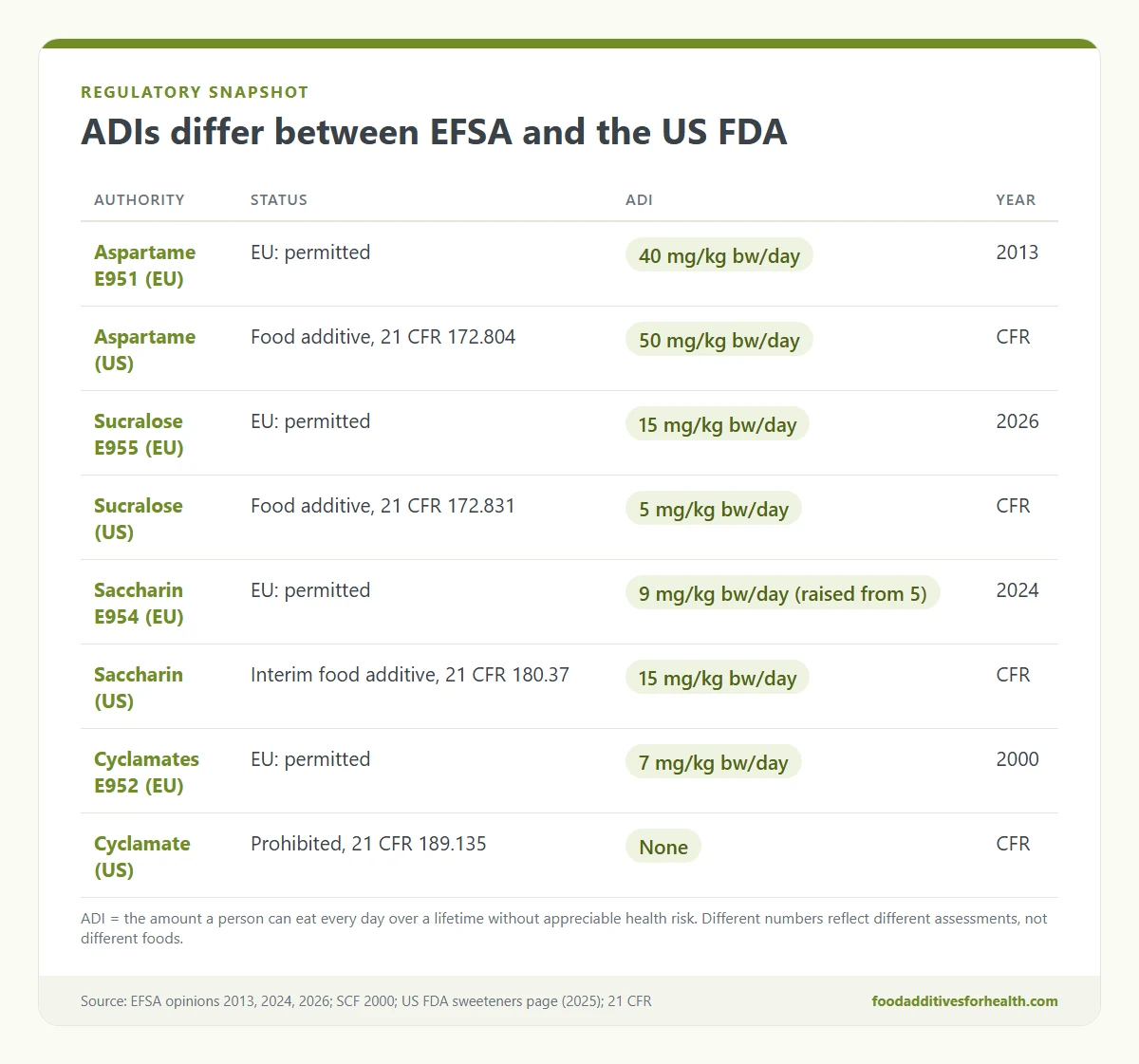
Here is how the main bodies compare. All values are ADIs in mg per kg of body weight per day, except erythritol (grams). JECFA is the joint FAO/WHO expert committee that evaluates additives.
| Sweetener | EFSA (year) | JECFA | US FDA |
|---|---|---|---|
| Aspartame E951 | 40 (2013) | 0–40, reaffirmed 2023 (WHO) | 50 (FDA) |
| Acesulfame K E950 | 15 (2025) | 0–15 (JECFA) | 15 (FDA) |
| Saccharin E954 | 9 (2024) | 0–5 (JECFA database*) | 15; interim listing (21 CFR 180.37) |
| Sucralose E955 | 15 (2026) | 0–15 (JECFA database*) | 5 (FDA) |
| Steviol glycosides E960 | 4, as steviol (2010) | 0–4, as steviol (JECFA) | 4, as steviol (FDA) |
| Neotame E961 | 10 (2025) | 0–2 (FAO) | 0.3 (FDA) |
| Cyclamates E952 | 7, as cyclamic acid (SCF, 2000) | 0–11 (JECFA database*) | Prohibited (21 CFR 189.135) |
| Erythritol E968 | 0.5 g/kg (2023) | Not specified (JECFA database*) | Permitted (FDA) |
*JECFA values for saccharin, sucralose, cyclamates and erythritol are from the JECFA online database (search by substance name).
Where regulators differ
The gaps tell a useful story. Sucralose has an ADI of 15 at EFSA and JECFA but 5 at the FDA. These are different numbers for the same compound, yet all three bodies consider current use safe. Aspartame’s FDA figure (50) is higher than the EFSA and JECFA figure (40).
Cyclamate is the sharpest split. It is permitted in the EU and evaluated by JECFA, but food containing it is deemed adulterated in the US (21 CFR 189.135). A ban in one country is a regulatory difference, not proof of harm elsewhere.
Numbers also move when science does, and not in only one direction. EFSA raised the saccharin ADI from 5 to 9 in 2024, judging that male-rat bladder tumours were not relevant to humans (EFSA, 2024). It raised acesulfame K from 9 to 15 in 2025 (EFSA, 2025) and neotame from 2 to 10 in 2025 (EFSA, 2025). The erythritol ADI of 0.5 g/kg was set in 2023. EFSA estimated that intake in all population groups was above it, while noting that its estimates likely overstated real intake, and said people with a high intake may experience adverse effects (EFSA, 2023). Reviews of other polyols and of cyclamate are ongoing (EFSA, 2026).
For monk fruit, EFSA concluded in 2019 that the data were insufficient to judge its safety as a food additive (EFSA, 2019). The FDA has received GRAS notices for it, raised no questions, and states that no ADI has been specified (FDA).
Aspartame: hazard versus risk
In 2023, the International Agency for Research on Cancer (IARC) classified aspartame as Group 2B, “possibly carcinogenic to humans”, based on limited evidence, including limited evidence for liver cancer in people (WHO, 2023; Riboli et al., 2023). The same week, JECFA kept the ADI at 0 to 40 mg/kg bw/day.
These are two different questions. IARC asks about hazard: could it cause cancer under some conditions? JECFA asks about risk: at what intake is it safe? JECFA estimated that a 70 kg adult would need to drink more than 9 to 14 cans a day of a diet drink containing 200 to 300 mg of aspartame to exceed the ADI (WHO, 2023). The FDA disagrees with IARC’s conclusion (FDA).
Sweeteners and diabetes
WHO’s 2023 guideline on non-sugar sweeteners explicitly excludes people with pre-existing diabetes (WHO, 2023). In its 2022 evidence review, randomised trials showed little effect on glucose metabolism (WHO, 2022). Choosing a sweetener when you manage diabetes is an individual decision, so it is one to take to your doctor or dietitian.
Myths vs facts
Myth: “Artificial sweeteners cause cancer.” Regulators find no concern within the ADI. IARC’s aspartame rating reflects limited evidence of hazard, and JECFA kept its ADI in 2023 (see above). Old rat bladder tumours with saccharin were judged specific to male rats and not relevant to humans (EFSA, 2024). Observational data are more mixed. A large French cohort found an association between artificial sweetener intake and higher cancer risk (Debras et al., 2022). Scientists disagree on how to read it, since observational studies cannot rule out other explanations such as diet and lifestyle.
Myth: “Natural sweeteners are automatically safer.” Stevia has an ADI of 4 mg/kg like any other additive (EFSA, 2010). Crude stevia leaf is not GRAS in the US (FDA), and in 2019 EFSA found monk fruit data insufficient (EFSA, 2019). “Natural” describes the source, not the safety assessment.
Myth: “Sugar alcohols are calorie-free and harmless in any amount.” They contain calories (WHO, 2023), and eating a lot has a laxative effect, as the erythritol ADI shows (EFSA, 2023). On erythritol and heart health, one 2023 study linked blood erythritol to cardiovascular events in high-risk people and found effects on platelets in lab and mouse work (Witkowski et al., 2023). The FDA said in 2023 that observational studies did not establish causation (FDA). The body also makes some erythritol itself (PMC10242034). That question remains open.
Myth: “Sweeteners are proven to make you gain weight” or “proven to help you lose weight.” Neither is established. A 2019 BMJ review found most health outcomes did not differ between people who used non-sugar sweeteners and those who did not (Toews et al., 2019). WHO’s 2022 review found a small short-term weight loss in trials but no clear long-term consensus (WHO, 2022). WHO’s 2023 advice against using them for weight control is conditional (WHO, 2023), and it sits alongside, not in place of, the ADIs set by food safety regulators.
How to spot sweeteners on a label
Sweeteners must be listed by name or E-number in the EU (EFSA), whereas US labels use names rather than E-numbers.
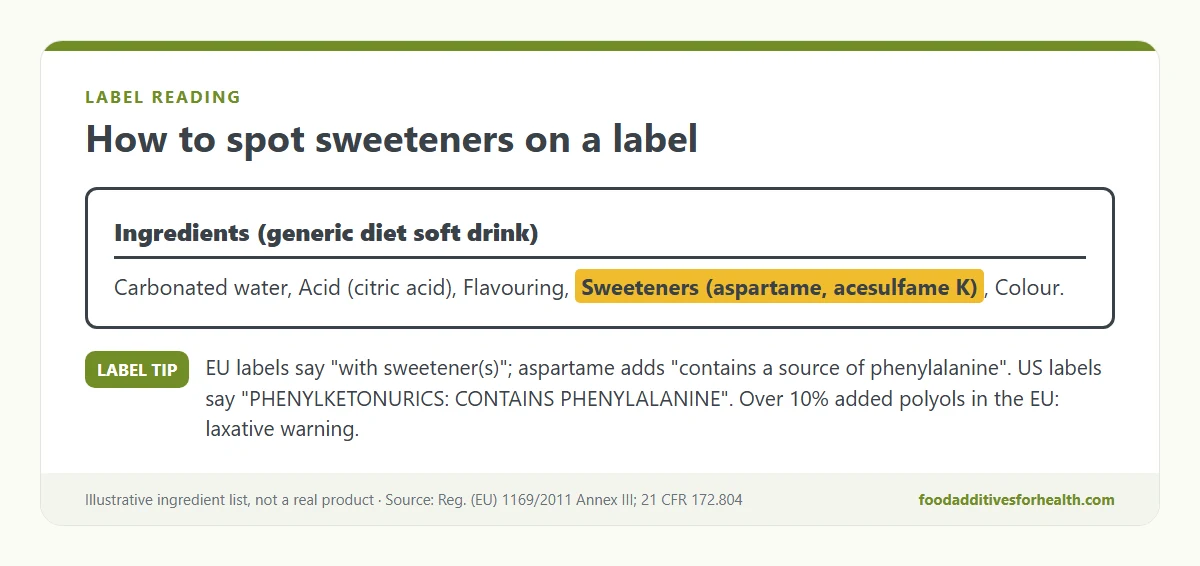
In the EU, look for the words “with sweetener(s)”, or “with sugar(s) and sweetener(s)” when both are present. Products with aspartame must state “contains aspartame (a source of phenylalanine)”, or “contains a source of phenylalanine” if listed by name. Foods with more than 10% added polyols must say “excessive consumption may produce laxative effects” (Regulation 1169/2011).
In the US, aspartame-containing foods carry “PHENYLKETONURICS: CONTAINS PHENYLALANINE” (21 CFR 172.804). Sorbitol products that could lead to 50 g/day intake must say “Excess consumption may have a laxative effect.” (21 CFR 184.1835).
Names to recognise: acesulfame K is also Ace-K or acesulfame potassium (E950); saccharin includes its sodium, potassium and calcium salts (E954); stevia extract may appear as steviol glycosides or rebaudioside A or M (E960); monk fruit appears as luo han guo extract or mogrosides; and polyols often end in “-itol”.
FAQ
How many types of sweeteners are there?
Three main families: sugars, sugar alcohols and high-intensity sweeteners. The last splits into synthetic and plant-derived branches.
What types of artificial sweeteners are there?
The synthetic high-intensity group includes acesulfame K, aspartame, cyclamates, saccharin, sucralose, neotame, aspartame-acesulfame salt and advantame (EFSA). Cyclamates are not permitted in the US.
Which sweeteners are safe?
Regulators judge each approved sweetener safe at intakes up to its ADI. For aspartame, JECFA’s example shows how much that is: a 70 kg adult would need more than 9 to 14 cans of diet drink a day to exceed it (WHO, 2023). Erythritol is an exception worth knowing: EFSA estimated that intakes can exceed its ADI (EFSA, 2023). Special cases: EFSA’s aspartame ADI does not apply to people with PKU, who need to count it as a source of phenylalanine (EFSA), and polyols can have a laxative effect.
What sweeteners can people with diabetes use?
The FDA says polyols do not cause a sudden increase in blood glucose (FDA). Individual choices depend on your treatment plan, so ask your doctor or dietitian.
Are sugar alcohols artificial sweeteners?
Not usually classed that way. They contain calories, and WHO excludes them from its non-sugar sweetener category (WHO, 2023).
Is monk fruit an artificial sweetener?
No. It is a plant-derived high-intensity sweetener, about 100 to 250 times sweeter than sugar (FDA).
Bottom Line
Sweeteners are not one thing. Sugars, sugar alcohols and high-intensity sweeteners work differently, are assessed differently and carry different label rules. Dose is what matters: for each approved sweetener, regulators find no concern at intakes within its ADI, even where their numbers differ, and approval itself differs between countries. WHO advises keeping free sugars below 10% of energy, with below 5% suggested (WHO, 2015), and it conditionally advises against relying on non-sugar sweeteners to control weight. Read labels, vary what you eat, and treat “natural” and “artificial” as descriptions of origin, not verdicts on safety.
References
- EFSA. Sweeteners (topic page, reviewed 27 Oct 2026). https://www.efsa.europa.eu/en/topics/topic/sweeteners
- EFSA FAF Panel. Update on the re-evaluation of sweeteners, 67th FAF plenary, 1–2 July 2026. https://www.efsa.europa.eu/sites/default/files/2026-07/Annex%20II_10.1%20Update%20on%20the%20re-evaluation%20of%20sweeteners_%201-2%20July%202026.pdf
- EFSA ANS Panel (2013). Scientific Opinion on the re-evaluation of aspartame (E 951). EFSA Journal 11(12):3496. https://efsa.onlinelibrary.wiley.com/doi/10.2903/j.efsa.2013.3496 ; topic page https://www.efsa.europa.eu/en/topics/topic/aspartame
- EFSA FAF Panel (2025). Re-evaluation of acesulfame K (E 950). EFSA Journal 2025:9317. https://www.efsa.europa.eu/en/plain-language-summary/re-evaluation-acesulfame-k-e-950-food-additive
- EFSA FAF Panel (2024). Re-evaluation of saccharin and its Na, K, Ca salts (E 954). EFSA Journal 22(11):e9044. https://www.efsa.europa.eu/en/news/saccharin-safety-threshold-increased
- EFSA FAF Panel (2026). Re-evaluation of sucralose (E 955). EFSA Journal 2026:9854. https://www.efsa.europa.eu/en/plain-language-summary/re-evaluation-sucralose-e-955-food-additive
- EFSA FAF Panel (2025). Re-evaluation of neotame (E 961). EFSA Journal 23(7):9480. https://www.efsa.europa.eu/en/efsajournal/pub/9480
- EFSA FAF Panel (2023). Re-evaluation of erythritol (E 968). EFSA Journal 2023:8430. https://www.efsa.europa.eu/en/plain-language-summary/re-evaluation-erythritol-e-968-food-additive
- EFSA ANS Panel (2010). Safety of steviol glycosides for the proposed uses as a food additive. EFSA Journal 8(4):1537. https://www.efsa.europa.eu/en/efsajournal/pub/1537
- EFSA FAF Panel (2019). Safety of use of monk fruit extract as a food additive. EFSA Journal 2019:5921. https://www.efsa.europa.eu/en/efsajournal/pub/5921
- Scientific Committee on Food (2000). Revised opinion on cyclamic acid and its sodium and calcium salts. https://ec.europa.eu/food/fs/sc/scf/out53_en.pdf
- Regulation (EU) No 1169/2011, Annex III. https://eur-lex.europa.eu/eli/reg/2011/1169/oj/eng
- US FDA. Aspartame and Other Sweeteners in Food (updated 27 Feb 2025). https://www.fda.gov/food/food-additives-petitions/aspartame-and-other-sweeteners-food
- 21 CFR 172.804 Aspartame. https://www.ecfr.gov/current/title-21/chapter-I/subchapter-B/part-172/subpart-I/section-172.804
- 21 CFR 180.37 Saccharin (interim). https://www.ecfr.gov/current/title-21/chapter-I/subchapter-B/part-180/subpart-B/section-180.37
- 21 CFR 189.135 Cyclamate and its derivatives. https://www.ecfr.gov/current/title-21/chapter-I/subchapter-B/part-189/subpart-C/section-189.135
- 21 CFR 184.1835 Sorbitol; 21 CFR 184.1854 Sucrose. https://www.ecfr.gov/current/title-21/chapter-I/subchapter-B/part-184/subpart-B/section-184.1835 ; https://www.ecfr.gov/current/title-21/chapter-I/subchapter-B/part-184/subpart-B/section-184.1854
- JECFA database: acesulfame potassium https://apps.who.int/food-additives-contaminants-jecfa-database/Home/Chemical/926 ; steviol glycosides https://apps.who.int/food-additives-contaminants-jecfa-database/Home/Chemical/267 ; sweetening agents class https://apps.who.int/food-additives-contaminants-jecfa-database/search.aspx?fc=66 ; neotame specification https://www.fao.org/fileadmin/user_upload/jecfa_additives/docs/Monograph1/Additive-294.pdf
- WHO (14 Jul 2023). Aspartame hazard and risk assessment results released. https://www.who.int/news/item/14-07-2023-aspartame-hazard-and-risk-assessment-results-released
- Riboli E, et al. (2023). Carcinogenicity of aspartame, methyleugenol, and isoeugenol. Lancet Oncol 24(8):848–850. https://doi.org/10.1016/S1470-2045%2823%2900341-8
- WHO (2023). Use of non-sugar sweeteners: WHO guideline (news, 15 May 2023). https://www.who.int/news/item/15-05-2023-who-advises-not-to-use-non-sugar-sweeteners-for-weight-control-in-newly-released-guideline
- WHO (2022). Health effects of the use of non-sugar sweeteners: a systematic review and meta-analysis. https://www.who.int/publications/i/item/9789240046429
- WHO (2015). Guideline: sugars intake for adults and children. https://www.who.int/news/item/04-03-2015-who-calls-on-countries-to-reduce-sugars-intake-among-adults-and-children
- Toews I, et al. (2019). Association between intake of non-sugar sweeteners and health outcomes. BMJ 364:k4718. https://pubmed.ncbi.nlm.nih.gov/30602577/
- Debras C, et al. (2022). Artificial sweeteners and cancer risk: NutriNet-Santé. PLoS Med 19:e1003950. https://journals.plos.org/plosmedicine/article?id=10.1371/journal.pmed.1003950
- Witkowski M, et al. (2023). The artificial sweetener erythritol and cardiovascular event risk. Nat Med 29:710–718. https://www.nature.com/articles/s41591-023-02223-9
- “Mechanisms for Sweetness” (review). https://pmc.ncbi.nlm.nih.gov/articles/PMC3738222/ ; “The Functional Role of the T1R Family of Receptors in Sweet Taste and Feeding”. https://pmc.ncbi.nlm.nih.gov/articles/PMC3186843/
- Plasma erythritol and endogenous production (PMC10242034). https://pmc.ncbi.nlm.nih.gov/articles/PMC10242034/
