

Glyceryl monostearate (GMS) is an emulsifier made from glycerol and stearic acid, two normal building blocks of dietary fat. Regulators have found no safety concern at the levels used in food. The European Food Safety Authority (EFSA) saw no need for a numerical acceptable daily intake when it re-evaluated the family GMS belongs to.
You will meet it on labels as “mono- and diglycerides” or “E471”, usually in bread, cakes, ice cream and spreads. This guide explains what GMS is, how it works, where it turns up, what regulators and researchers say, and how to read a label if you avoid animal ingredients. For the wider family, see our article on mono- and diglycerides (E471).
Key Takeaways
- What it is: a monoglyceride, meaning one stearic acid chain attached to a glycerol backbone; “glyceryl” and “glycerol” monostearate are the same substance.
- Where it is used: bread, cakes, ice cream, whipped toppings, margarine and infant formula.
- On the label: usually “mono- and diglycerides” or E471; GMS sits under INS 471.
- JECFA (1973): ADI “not limited”. EFSA (2017): no numerical ADI needed.
- FDA: affirmed GRAS (generally recognised as safe) under good manufacturing practice.
- Vegan or not: depends on the fat it was made from, which the label rarely states.
What is glyceryl monostearate?
Fats are built on a small three-carbon molecule called glycerol. A normal dietary fat, a triglyceride, carries three fatty acid chains on that backbone. A monoglyceride carries just one. In GMS the single chain is stearic acid, a saturated fatty acid with 18 carbons. The formula is C21H42O4 and the molecular weight is 358.6.
That one-chain design matters. The glycerol end of the molecule has two free hydroxyl groups (oxygen-hydrogen groups) that attract water. The stearic acid tail is oily. One molecule therefore has a water-loving head and a fat-loving tail, which is what makes it an emulsifier (a substance that helps oil and water mix and stay mixed). Our pillar article on Emulsifiers covers the general idea.
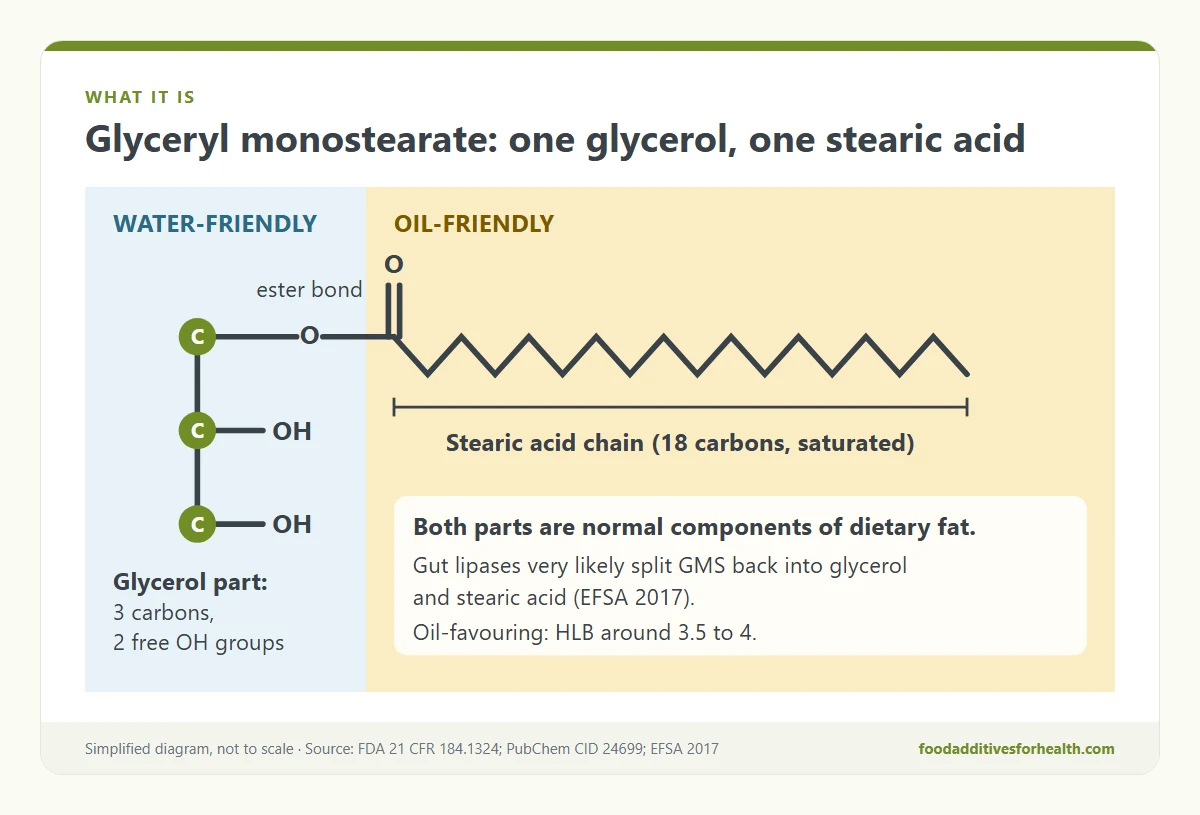
The name causes confusion. “Glyceryl” simply names the glycerol part when it sits inside an ester (a compound formed by joining an alcohol to an acid). So glyceryl monostearate, glycerol monostearate, monostearin and GMS all describe the same substance. The US Food and Drug Administration (FDA) uses glyceryl monostearate, and the WHO and FAO expert committee on additives (JECFA) lists GMS and monostearin as synonyms of mono- and diglycerides. In cosmetics the same sort of ingredient appears as “glyceryl stearate”; this article is about food only.
Commercial GMS is not a single pure molecule. The FDA describes it as a mixture of glyceryl monostearate, glyceryl monopalmitate and other glyceryl esters of commercial stearic acid, because commercial stearic acid itself contains other fatty acids. Manufacturers make it in two ways. One is glycerolysis, which starts from edible fats or oils. The other is direct esterification, where glycerin is reacted with stearic acid from edible sources, according to the FDA.
Suppliers sell different grades, often labelled GMS 40, 60 or 90, with the number loosely reflecting how much of the product is monoglyceride. The “90” grades are distilled monoglycerides, purified so that most of the product is monoglyceride rather than a mix of mono- and diglycerides. These grade numbers are an industry convention. Regulators do not define them, so treat them as rough descriptions rather than legal categories. Regulatory records also use different registry numbers: the FDA lists CAS 31566-31-1 for glyceryl monostearate, while JECFA lists 68953-43-5 for mono- and diglycerides.
How GMS works in food
Picture a salad dressing. Oil and vinegar separate because the two do not mix. An emulsifier sits at the boundary between them and lowers the tension that keeps them apart. GMS does this too, but it leans toward the oil side. Its HLB value (hydrophilic-lipophilic balance, a scale describing whether an emulsifier prefers water or oil) is around 3.5 to 4 according to one peer-reviewed table and supplier listings. Low numbers mean oil-loving. That suits water-in-oil products such as margarine and lets GMS act as a helper alongside other emulsifiers. Our guide to HLB value explains the scale in more detail.
In bread, the job is different. Fresh bread goes stale mainly because starch re-crystallises as it cools and ages, a process called retrogradation. Starch has two fractions. Amylose is the long straight-chain fraction, and amylopectin is the branched one. Monoglycerides slot into the helical coils of amylose and form inclusion complexes, much like a key held inside a spiral. Laboratory work has studied how this amylose-monoglyceride complex forms and crystallises in a starch matrix, and an older study of bread staling kinetics tested the effect of added monoglyceride. With amylose tied up, less of it can pack into hard crystals, so the crumb stays softer for longer. That is why GMS is called an anti-staling agent or crumb softener, not a preservative: it slows firming and does not stop microbes from growing.
Ice cream and whipped toppings depend on another trick. Their fat is dispersed as tiny droplets, and milk proteins normally coat those droplets. During whipping and freezing, you want the droplets to clump partially, so they form a network that traps air. GMS competes with milk protein at the droplet surface and changes how the fat crystallises. A lab study of whipped-frozen emulsions found that GMS retarded the start of milk fat crystal formation but accelerated crystal growth, with the effect depending on the type of fat. In practical terms, this helps produce a drier, smoother scoop that holds its shape and melts more slowly, though the exact result depends on the recipe.
Where you find GMS
GMS rarely appears alone on a label, but it shows up in many everyday categories. The FDA lists the functions of mono- and diglycerides as emulsifier, dough strengthener, stabiliser, thickener, texturiser and release agent.
| Food category | What GMS or mono- and diglycerides do |
|---|---|
| Bread, rolls, cakes | Soften the crumb, slow staling, strengthen dough |
| Ice cream and frozen desserts | Control fat clumping and air, smoother texture, slower melt |
| Whipped toppings and cream substitutes | Stabilise air bubbles and fat droplets |
| Margarine and spreads | Keep water droplets dispersed in the fat |
| Baking fats and release agents | Help baked goods release from tins and trays (FDA lists “release agent” as a function) |
| Infant formula and follow-on formula | Permitted by Codex up to 4,000 mg/kg |
Codex Alimentarius, the international food standards body, lists mono- and diglycerides (471) with the functions of emulsifier, stabiliser, antifoaming agent and glazing agent. In many foods it is allowed under good manufacturing practice (GMP), which means use only as much as is technologically needed. It also sets numerical maxima in some categories, including 4,000 mg/kg in infant and follow-up formula and 5,000 mg/kg in complementary foods.
Food makers sometimes reach for related ingredients instead, or alongside. Lecithin, enzymes and other emulsifiers can do overlapping jobs. If you want to compare, our articles on Sucrose esters of fatty acids (E473) and Polyglycerol Fatty Acid Esters (E475) cover two of them, and our overview of synthetic emulsifiers in food places GMS in context.
Is glyceryl monostearate safe? Safety and regulation
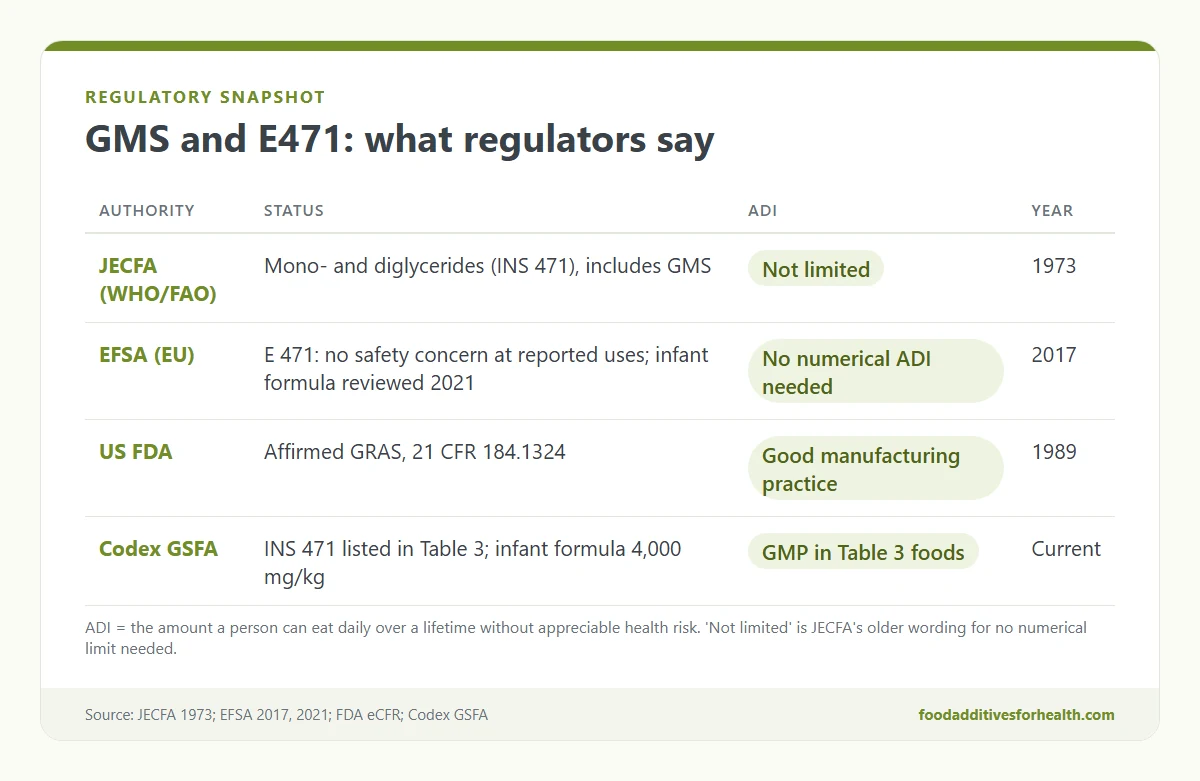
Yes, at the levels used in food, according to every regulator that has assessed it. No body has set a numerical acceptable daily intake (ADI, the amount you could eat daily over a lifetime without appreciable risk) for GMS, because the data did not call for one. Regulators assess GMS as part of the mono- and diglycerides family, not on its own.
| Body | Year | Conclusion |
|---|---|---|
| JECFA (WHO/FAO) | 1973 | ADI “not limited” |
| EFSA ANS Panel | 2017 | No safety concern at reported uses and use levels; no numerical ADI needed |
| EFSA FAF Panel | 2021 | No safety concern in infant formula and infant special medical foods |
| US FDA, 21 CFR 184.1324 | 1989, amended 2008 | Affirmed GRAS; no limit other than good manufacturing practice |
| Codex GSFA | current | GMP in most listed foods; numerical maxima for some infant foods |
“Not limited” is JECFA’s older phrase. It means the toxicity data showed no need for a numerical limit at the levels needed for technological purposes. It does not mean you should eat unlimited amounts, and Codex itself sets numerical maxima for infant formula.
Why are regulators comfortable? Part of the answer is digestion. EFSA considered it very likely that gut lipases (fat-digesting enzymes) split mono- and diglycerides into glycerol and fatty acids, both of which it had already re-evaluated with no safety concern. Monoglycerides also form naturally as a step in digesting dietary fat. The 2017 opinion reviewed short-term, subchronic, chronic, reproductive, developmental and genotoxicity (DNA damage) studies, and no adverse effects, no carcinogenic potential and no genotoxicity concern were reported. EFSA also estimated that mean intake of E471 was 0.8 to 3.5% of the recommended daily fat intake, a small amount in dietary terms.
Infants get extra attention. In 2021 EFSA reviewed use in foods for babies under 16 weeks and found no reason for safety concern in infant formula or infant special medical foods. It noted that infant exposure from E471 was similar in magnitude to the mono- and diacylglycerols in breast milk.
The open question is purity, not the molecule. When oils are refined at high temperature, contaminants can form, including glycidyl esters. EFSA’s contaminants panel noted that glycidol, which glycidyl esters release, is genotoxic and carcinogenic, with no safe level set. Because E471 can be made from refined oils, these impurities can carry over. That is a hazard of the contaminant, not of GMS itself. In 2021 EFSA recommended lower limits for arsenic, lead, cadmium and mercury and new limits for glycidyl esters, 3-MCPD and erucic acid in the EU specifications. (3-MCPD is another processing contaminant from refined fats; erucic acid is a fatty acid that EFSA also asked to be limited in the specifications.) We have not verified whether those limits have since been adopted, so check current EU specifications if this matters to you.
Researchers have also looked at emulsifier intake in large cohorts. In the French NutriNet-Santé study of about 92,000 adults, higher E471 intake was associated with a higher overall cancer risk (hazard ratio 1.15) and with higher breast and prostate cancer risk. A separate analysis linked E471 and E472 intake with cardiovascular outcomes. In the same cohort, E471 was not among the emulsifiers associated with type 2 diabetes. Scientists disagree about what these findings mean. They are observational: they estimate intake from food records, cannot separate GMS from other monoglycerides, and cannot rule out that the processed foods carrying these additives explain the pattern. They show association, not cause. No regulator we reviewed has changed its conclusion because of them.
Myths vs facts
Myth: GMS is a synthetic, plastic-like chemical. It is an ester of glycerol and stearic acid, both ordinary components of dietary fat. Gut enzymes split it back into those parts, according to EFSA. Monoglycerides also form during normal fat digestion and occur in breast milk.
Myth: Codex says there is no limit, so any amount is fine. The “not limited” wording came from JECFA in 1973, not Codex, and it reflects low toxicity at the amounts technologically needed. Codex sets numerical maxima for infant formula and complementary foods. In practice, the amounts in bread or ice cream are small.
Myth: emulsifiers like GMS are proven to cause cancer or heart disease. The cohort findings above are associations for the whole E471 group. They need confirmation, and they do not show that GMS causes disease.
Myth: glyceryl monostearate and glycerol monostearate are different ingredients. They are the same substance under two spellings, as described earlier.
How to spot GMS on a label
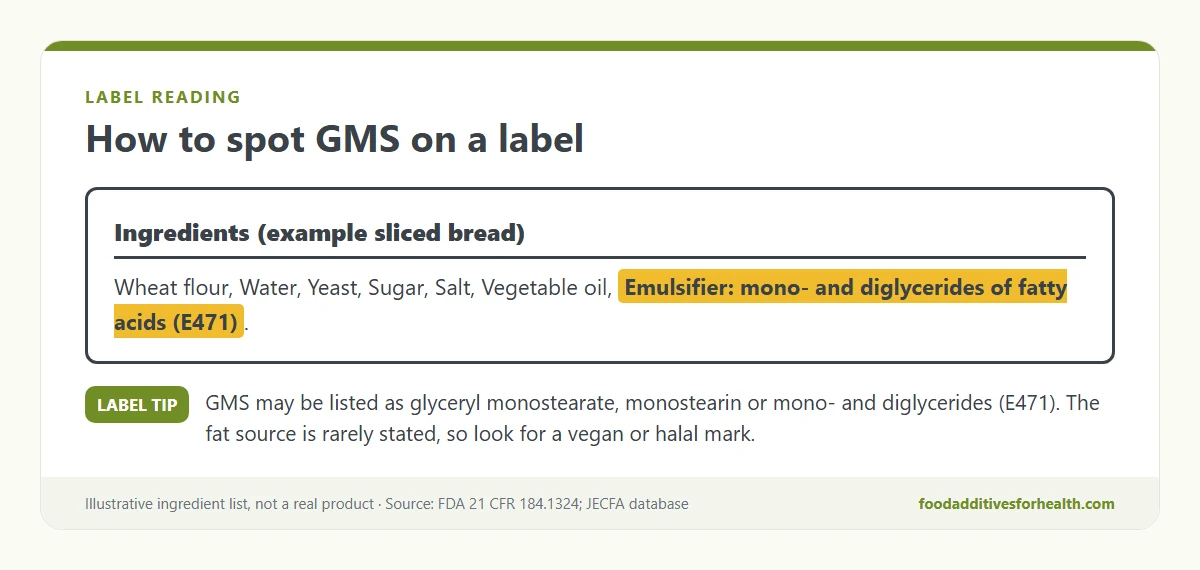
On an ingredient list, GMS will rarely say “glyceryl monostearate”. Look for these names: mono- and diglycerides, mono- and diglycerides of fatty acids, E471 (EU) or INS 471 (Codex). The names glyceryl monostearate, glycerol monostearate, GMS and monostearin appear in regulatory documents and on some supplier or ingredient specifications. “Distilled monoglycerides” is an industry term for high-monoglyceride grades, although the consumer label usually still reads E471 or mono- and diglycerides.
The harder question is where it came from. The FDA describes the source as edible fats or oils, which can be animal or vegetable, and labels rarely state which. So vegan and halal status depends on the raw material and on certification. If either matters to you, the reliable signals are a vegan or halal certification mark on the pack, or asking the manufacturer directly.
Gluten is more straightforward. GMS is made from fats and glycerol, not from grains, so it is not made from gluten-containing ingredients. That is not the same as a certified gluten-free claim, and no regulator source in our set makes one, so people with coeliac disease should still look for gluten-free labelling on the finished food.
FAQ
Is glyceryl monostearate vegan?
Not necessarily. It can be made from animal or vegetable fats, and the label usually does not say which. A vegan certification mark, or a reply from the manufacturer, is the only dependable way to know.
Is glyceryl monostearate halal?
It depends on the source of the fat and on certification, just as with vegan status. Because animal fat is a possible raw material, look for a halal mark or ask the producer.
Is glyceryl monostearate natural?
Its building blocks, glycerol and stearic acid, occur naturally in fats. The finished ingredient is made industrially, by glycerolysis of fats or by esterification of glycerin with stearic acid, per the FDA. Whether you call that “natural” is a matter of definition. The molecule is also digested into ordinary dietary fat components.
Is glyceryl monostearate gluten free?
It is made from fats and glycerol, not from wheat, barley or rye, so it is not made from gluten-containing grains. We found no regulator statement certifying it gluten free, so for coeliac disease rely on the labelling of the finished food.
What is the difference between glyceryl monostearate and glycerol monostearate?
Nothing. They are two spellings for the same substance. “Glyceryl” is the chemical name for the glycerol group when it is part of an ester. Both names, plus monostearin and GMS, refer to the substance the FDA lists under 21 CFR 184.1324.
Is glyceryl stearate the same as glyceryl monostearate?
“Glyceryl stearate” is the name used on cosmetic labels for a closely related ingredient. We did not review a regulator source on cosmetics, so this article stays with the food additive. In food, the labels to look for are mono- and diglycerides and E471.
Is GMS safe for babies?
EFSA reviewed E471 for infants under 16 weeks and found no reason for safety concern in infant formula and infant special medical foods. It also recommended tighter limits on contaminants in the specifications. If your baby has a medical condition, ask your paediatrician.
Bottom line
Glyceryl monostearate is a monoglyceride emulsifier built from glycerol and stearic acid. It keeps bread soft, helps ice cream stay smooth and holds spreads together. JECFA gave it an ADI of “not limited” in 1973, EFSA found no need for a numerical ADI in 2017, and the FDA lists it as GRAS. The live questions are impurity control and what observational studies on the wider E471 group mean. If you avoid animal products, look for certification, because the label will not tell you the fat source.
References
- Joint FAO/WHO Expert Committee on Food Additives (JECFA). Mono- and diglycerides (INS 471): evaluation, 17th meeting. 1973. https://apps.who.int/food-additives-contaminants-jecfa-database/Home/Chemical/917
- EFSA Panel on Food Additives and Nutrient Sources added to Food (ANS). Re-evaluation of mono- and di-glycerides of fatty acids (E 471) as food additives. EFSA Journal 2017;15(11):5045. https://doi.org/10.2903/j.efsa.2017.5045
- EFSA Panel on Food Additives and Flavourings (FAF). Opinion on the re-evaluation of mono- and diglycerides of fatty acids (E 471) as food additive in foods for infants below 16 weeks of age and follow-up of their re-evaluation for all population groups. EFSA Journal 2021;19(11):6885. https://doi.org/10.2903/j.efsa.2021.6885
- US Food and Drug Administration. 21 CFR 184.1324 Glyceryl monostearate. eCFR (current). https://www.ecfr.gov/current/title-21/chapter-I/subchapter-B/part-184/subpart-B/section-184.1324
- US Food and Drug Administration. 21 CFR 184.1505 Mono- and diglycerides. eCFR (current). https://www.ecfr.gov/current/title-21/part-184/section-184.1505
- Codex Alimentarius Commission. GSFA Online: Mono- and di-glycerides of fatty acids (471). https://codex.fao.org/codex-texts/codex-online-databases/gsfa/food-additives-list/food-additive-details?additiveId=d979e6b8-249a-f111-b8dc-70a8a5613865
- EFSA. Process contaminants in vegetable oils and foods (3-MCPD, 2-MCPD and glycidyl esters). 2016. https://www.efsa.europa.eu/en/press/news/process-contaminants-vegetable-oils-and-foods
- Sellem L, Srour B, Javaux G, et al. Food additive emulsifiers and cancer risk: results from the French prospective NutriNet-Santé cohort. PLoS Medicine. 2024. https://doi.org/10.1371/journal.pmed.1004338
- Sellem L, Srour B, Javaux G, et al. Food additive emulsifiers and risk of cardiovascular disease in the NutriNet-Santé cohort: prospective cohort study. BMJ. 2023. https://doi.org/10.1136/bmj-2023-076058
- Salame C, Javaux G, Sellem L, et al. Food additive emulsifiers and the risk of type 2 diabetes: analysis of data from the NutriNet-Santé prospective cohort study. Lancet Diabetes & Endocrinology. 2024. https://doi.org/10.1016/S2213-8587(24)00086-x
- Formation and crystallization of amylose-monoglyceride complex in a starch matrix. Carbohydrate Polymers. 2000. https://doi.org/10.1016/S0144-8617(00)00179-X
- A kinetic study of bread staling by differential scanning calorimetry and compressibility measurements: the effect of added monoglyceride. Journal of Cereal Science. 1983. https://doi.org/10.1016/S0733-5210(83)80017-4
- Influence of interfacial adsorption of glyceryl monostearate and proteins on fat crystallization behavior and stability of whipped-frozen emulsions. Food Chemistry. 2020. https://doi.org/10.1016/j.foodchem.2019.125949
- National Center for Biotechnology Information. PubChem Compound Summary for CID 24699, Monostearin. https://pubchem.ncbi.nlm.nih.gov/compound/24699
- OCL (Oilseeds and fats, Crops and Lipids). 2022, article ocl210096, Table 4 (HLB values). https://www.ocl-journal.org/articles/ocl/full_html/2022/01/ocl210096/T4.html
