

There is no single best emulsifier. The best one is the one matched to the job. An emulsifier is an ingredient that helps oil and water stay mixed instead of separating, and the right choice depends on what you are mixing and what texture you want at the end.
This guide covers seven emulsifiers you will meet again and again on food labels: lecithin, mono- and diglycerides, egg yolk, sodium stearoyl lactylate, sucrose esters, polyglycerol esters and ammonium phosphatides. For each, you will see what it does best and what regulators have concluded.
Key Takeaways
- Match the emulsifier to the job. Oil-in-water foods such as mayonnaise and milk, and water-in-oil foods such as butter, favour different emulsifier types (Xiao et al., 2025).
- HLB is a rough guide, not a ranking. Roughly 3 to 6 favours water-in-oil and roughly 8 to 18 favours oil-in-water (Li and Wu, 2025).
- Regulators have evaluated the six additives; egg yolk is a food. In 2017, EFSA concluded there was no need for a numerical ADI for lecithin and none for E 471.
- ADIs differ. For example, EFSA set 22 mg/kg bw/day for SSL and a group ADI of 40 mg/kg bw/day for sucrose esters.
- Gut-health research focuses on other emulsifiers. Mouse and human trial findings concern carboxymethylcellulose and polysorbate 80, not these seven (Chassaing et al., 2015).
What makes an emulsifier “good”?
Oil and water do not mix. Shake them together and the oil breaks into droplets, but the droplets soon find each other and merge.
An emulsifier fixes this because its molecules are amphiphilic (they have a water-loving head and an oil-loving tail). They settle at the boundary between oil and water, the interface, and lower the tension there. They also form a thin film around each droplet that stops the droplets from merging (Xiao et al., 2025). See our guide to what emulsifiers are.
Not every emulsifier is a small synthetic-looking molecule. Food scientists group them into small-molecule surfactants (such as mono- and diglycerides), phospholipids (lecithin), proteins (egg and milk), polysaccharides (gum arabic) and fine particles (Tan and McClements, 2021). Our post on types of emulsifiers covers that classification in detail.
A “good” emulsifier does three jobs. It helps form the emulsion, keeps it stable over shelf life, and sometimes changes texture, for instance how fat crystallizes or how starch behaves. No single molecule does all of this equally well, so food makers keep a toolbox.
How to match an emulsifier to the emulsion
The first question is which phase is continuous, meaning which liquid surrounds the droplets of the other. In an oil-in-water (O/W) emulsion, oil droplets float in water. Mayonnaise, salad dressings and milk are examples, and you can see more in our list of oil-in-water emulsions in food. In a water-in-oil (W/O) emulsion, tiny water droplets sit in oil, as in butter and margarine (Xiao et al., 2025; Foods, 2021). See also our examples of water-in-oil emulsions.
A second rough guide is the hydrophilic-lipophilic balance, or HLB, a scale introduced by Griffin in 1949 that runs from about 0 to 20. It describes whether a molecule is more oil-loving (low numbers) or more water-loving (high numbers). As a rule of thumb, values of roughly 3 to 6 favour W/O emulsions, while roughly 8 to 18 favour O/W emulsions; some sources put the lower O/W cut-off at 10 (Li and Wu, 2025; Golodnizky and Davidovich-Pinhas, 2020). Published values include about 3.8 for glycerol monostearate, about 7 for lecithin and roughly 1 to 16 for sucrose esters, depending on esterification (Golodnizky and Davidovich-Pinhas, 2020). See HLB values.
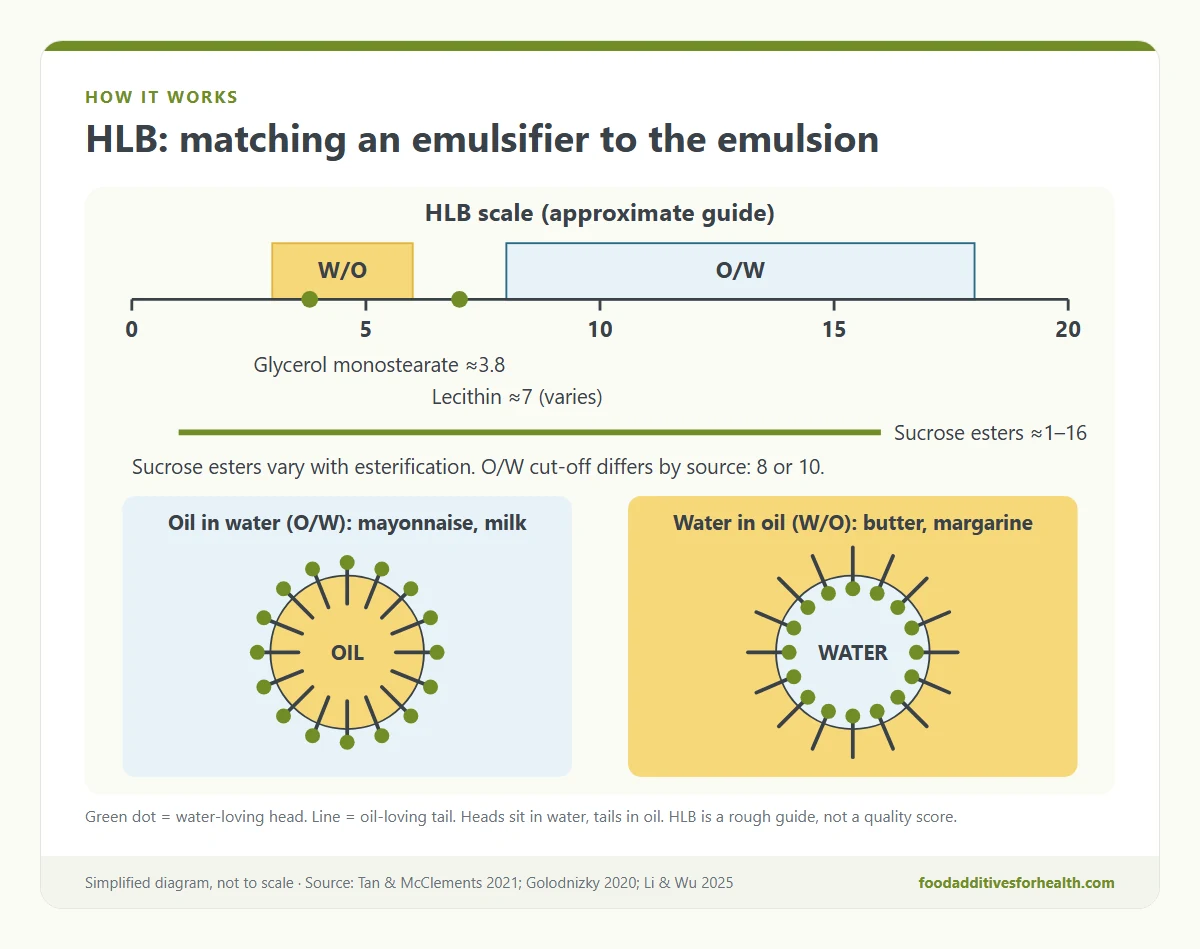
Another rule of thumb, the Bancroft rule, says the liquid in which an emulsifier dissolves better tends to become the continuous phase (Golodnizky and Davidovich-Pinhas, 2020). It is a tendency, not a law. Proteins and fine particles can also stabilize droplets.
So what is the best emulsifier for oil in water? In practice, one at the water-loving end of the HLB range, or a protein or phospholipid system such as egg yolk. For water in oil, look at the oil-loving end. See also alpha-tending and beta-tending emulsifiers.
The 7 best food emulsifiers and where you find them
Lecithin (E 322)
Lecithin is a mixture of phospholipids, the same kind of fat-based molecules found in cell membranes. It is a classic natural emulsifier, and its HLB is around 7 (Golodnizky and Davidovich-Pinhas, 2020). On labels it may appear as soy, sunflower or egg lecithin. In the US it is GRAS, with no limit other than good manufacturing practice (21 CFR 184.1400). Soy and egg lecithins come from allergen sources, which matters for people with allergies.
Mono- and diglycerides of fatty acids (E 471)
Mono- and diglycerides are fats in which one or two fatty acids, rather than three, are attached to a glycerol backbone. Codex lists their functions as emulsifier, stabilizer, antifoaming agent and glazing agent (Codex GSFA). Glycerol monostearate, a member of this family, has an HLB of about 3.8, so it leans oil-loving (Li and Wu, 2025). In the body it is digested like ordinary dietary fat (EFSA, 2017).
Egg yolk
Egg yolk is a food, not an additive, and it is still among the most effective emulsifiers in the kitchen. Most of its power comes from its plasma fraction, where fats are organized into lipoprotein particles, with phospholipids also contributing (Anton, 2013). That makes it the backbone of mayonnaise, which is an O/W emulsion typically holding 70 to 80% oil (Xiao et al., 2025). In the US, the mayonnaise standard requires at least 65% vegetable oil and an egg-yolk-containing ingredient. See also emulsifiers in global cuisines.
Sodium stearoyl lactylate, SSL (E 481)
SSL acts as an emulsifier, stabilizer, texturizer and dough strengthener in baked goods. It is also used in creamers, dehydrated potatoes and sauces, according to the US food additive regulation. Its calcium salt is E 482. See sodium stearoyl lactylate.
Sucrose esters of fatty acids (E 473)
Sucrose esters join sugar to fatty acids. Because the number of attached fatty acids can be adjusted, their HLB can be tuned across a wide range. FDA rules list uses in baked goods, frozen dairy desserts, whipped milk products and coffee or tea drinks containing dairy (21 CFR 172.859).
Polyglycerol esters of fatty acids, PGE (E 475)
Polyglycerol esters are built from glycerol units joined into short chains and attached to fatty acids. FDA lists them as a cloud inhibitor in vegetable and salad oils (stopping them going hazy when chilled) and as part of dry whipped topping bases (21 CFR 172.854). Do not confuse E 475 with E 476, PGPR, which is a different additive.
Ammonium phosphatides (E 442)
Ammonium phosphatides are the least familiar of the seven. JECFA, the joint FAO/WHO expert committee on additives, classes them as an emulsifier and lists them under the name ammonium salts of phosphatidic acid (JECFA). Regulators have evaluated them in detail.
Safety and regulation: what the ADIs say
The acceptable daily intake (ADI) is the amount of a substance that can be eaten every day over a lifetime without appreciable health risk. It is usually the highest no-effect dose in animal studies divided by 100. JECFA’s polyglycerol ester ADI is an example: a no-effect level of 2,500 mg/kg bw (body weight) in a long-term rat study, divided by 100, gives 0 to 25 mg/kg bw (JECFA).
| Emulsifier | EFSA | JECFA | US FDA |
|---|---|---|---|
| Lecithin (E 322) | 2017: no need for a numerical ADI (EFSA) | ADI not limited, 1973 (JECFA) | GRAS, 21 CFR 184.1400 (eCFR) |
| Mono- and diglycerides (E 471) | 2017: no need for a numerical ADI (EFSA) | ADI not limited, 1973 (JECFA) | GRAS, 21 CFR 184.1505 (eCFR) |
| SSL (E 481) | 2013: ADI 22 mg/kg bw/day (EFSA) | ADI 0-20 mg/kg bw, 1973 (JECFA) | Food additive, 21 CFR 172.846 (eCFR) |
| Sucrose esters (E 473) | Group ADI 40 mg/kg bw/day, set 2004 (EFSA) | Group ADI 0-30 mg/kg bw, 2020 (JECFA) | Food additive, 21 CFR 172.859 (eCFR) |
| PGE (E 475) | 2017: no need for a numerical ADI (EFSA) | ADI 0-25 mg/kg bw (JECFA) | Food additive, 21 CFR 172.854 (eCFR) |
| Ammonium phosphatides (E 442) | 2016: no reason to revise the ADI of 30 mg/kg bw/day (EFSA) | ADI 0-30 mg/kg bw, 1974 (JECFA) | Not covered here |
| Egg yolk | Food, no ADI; egg is a labelled allergen (FDA) | n/a | Food |
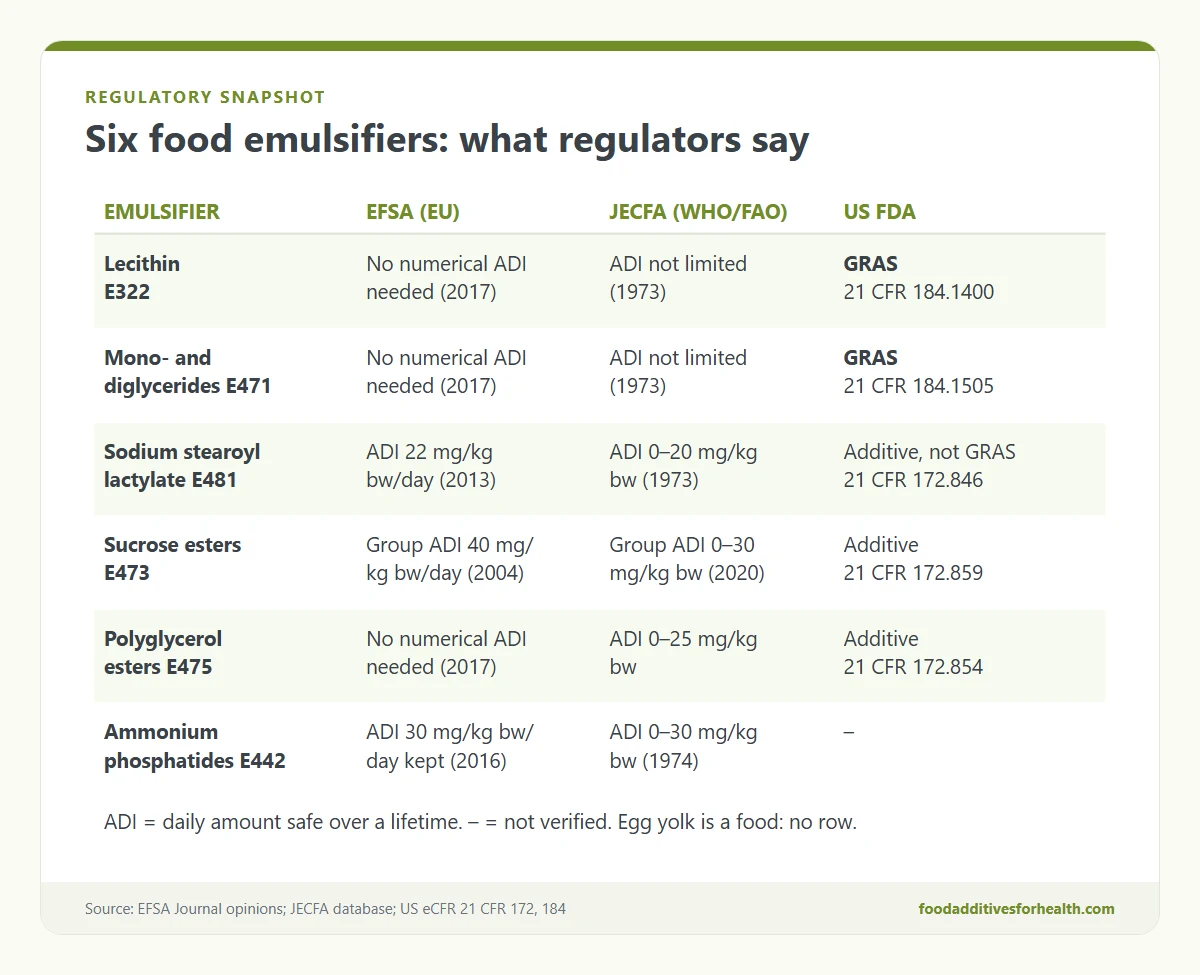
“GRAS” (generally recognized as safe, a US legal category) applies to only two of these: lecithin and mono- and diglycerides, both listed in 21 CFR Part 184. SSL, sucrose esters and polyglycerol esters are regulated food additives in 21 CFR Part 172, with specific conditions of use. For example, SSL is limited to levels such as up to 0.5 part per 100 parts flour in baked products and 0.3% in coffee creamers (21 CFR 172.846).
“No numerical ADI needed” does not mean “unlimited”. JECFA’s “not limited” wording means the substance is of very low toxicity and that intake at the levels needed for the food technology is not a health hazard (JECFA, lecithin). EFSA’s phrase carries the same meaning.
The most useful comparison is realistic intake against the ADI, since hazard (what a substance could do at some dose) is not the same as risk (what it does at the dose people actually eat). Mono- and diglycerides are digested like ordinary dietary fat into glycerol and fatty acids, and EFSA estimated E 471 supplies 0.8 to 3.5% of the recommended daily fat intake at the mean (EFSA, 2017). Polyglycerol esters are also rapidly and almost fully broken down in the gut (EFSA, 2017).
Two items carry real nuance. For sucrose esters, conservative exposure estimates for toddlers and children can exceed the ADI. EFSA noted this in 2018 and 2023, and JECFA’s 2020 estimate for children aged 3 to 9 was 113 mg/kg bw/day. Both bodies treated these as likely overestimates or asked for refined data, not as observed harm (EFSA, 2023; JECFA, 2020). For SSL, a Belgian study found that with measured food concentrations, intake stayed below the ADI in all age groups except about 1.9% of children (Food Addit Contam, 2018).
ADIs differ across bodies for SSL (22 versus 0 to 20 mg/kg bw) and PGE (no numerical ADI versus 0 to 25) because the assessments were done in different years with different data, not because of a dispute over harm.
Are emulsifiers good for health? Regulators reviewed the toxicology of the six additives here and found no safety concern at permitted uses, while asking for better intake data on sucrose esters. Egg yolk is a food, not an assessed additive. See also side effects of emulsifiers.
Myths vs facts
“Natural emulsifiers are always safer.” Safety depends on dose and structure, not origin. EFSA reached the same “no numerical ADI needed” conclusion for natural lecithin and for E 471 in 2017 (lecithin; E 471). Egg yolk is entirely natural, and eggs are a major allergen (FDA). See natural emulsifiers.
“All emulsifiers damage your gut.” The headline studies involve carboxymethylcellulose (CMC) and polysorbate 80. In mice given either one at 1% in drinking water for 12 weeks, researchers saw low-grade inflammation and metabolic changes (Chassaing et al., 2015). A randomized human feeding study of CMC reported reduced microbiota diversity (Chassaing et al., 2022). In a lab test on human gut bacteria, lecithin had no significant effect (Naimi et al., 2021). Human trials have not shown this for the seven emulsifiers in this article.
“Every food emulsifier is GRAS.” Only lecithin and mono- and diglycerides are (21 CFR 184). “Not limited” also does not mean unlimited (JECFA).
“Emulsifiers are proven to cause cancer or heart disease.” Scientists disagree about what the evidence shows. In French NutriNet-Santé cohort studies, higher intakes of E 471 and E 472 and of celluloses were associated with slightly higher cardiovascular risk (Sellem et al., 2023). Higher E 471 intake was also associated with cancer, with a hazard ratio of 1.15 overall comparing high with low intake (Sellem et al., 2024). A 2024 analysis of the same cohort also reported associations with type 2 diabetes (Salame et al., 2024). These are observational: they show associations and cannot separate an emulsifier from the ultra-processed foods that carry it. In the sources reviewed here, no regulator has changed its conclusion on these seven because of them.
How to read labels
Emulsifiers appear by name or by E-number (INS number in Codex and JECFA). EU labels give the function plus either the name or number, as in “emulsifier (E 471)”. Here is what to look for:
- E 322: lecithin, soy lecithin, sunflower lecithin, egg lecithin.
- E 471: mono- and diglycerides (of fatty acids), glyceryl monostearate.
- E 481 / E 482: sodium or calcium stearoyl-2-lactylate, SSL, CSL.
- E 473: sucrose esters of fatty acids.
- E 475: polyglycerol esters of fatty acids. Not the same as E 476.
- E 442: ammonium phosphatides.
- Egg yolk: listed as egg or egg yolk, with no E-number.
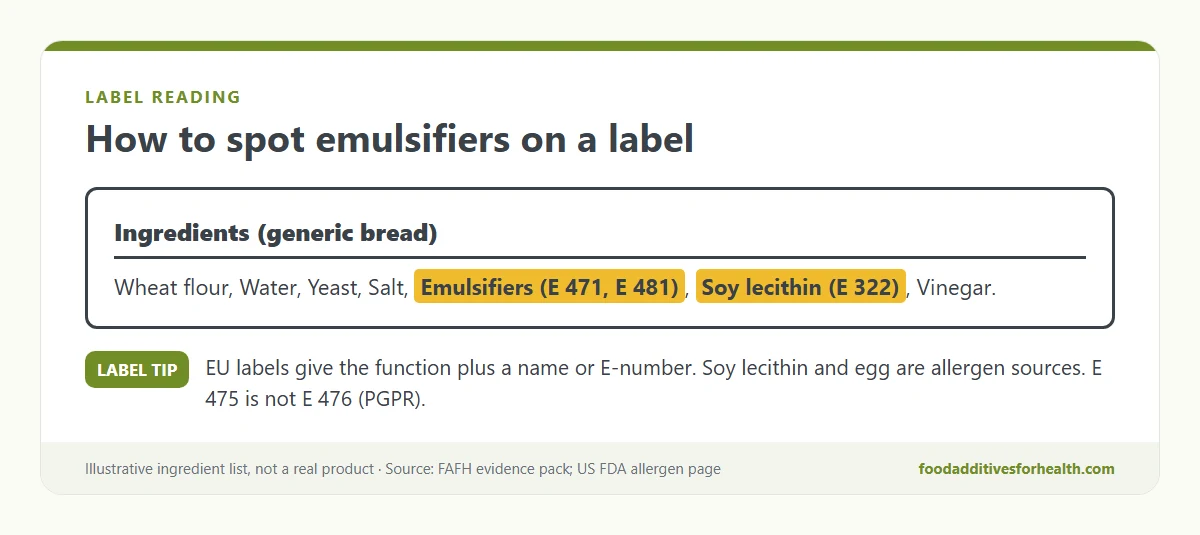
Allergen sources deserve a second look. Soy lecithin and egg lecithin come from soy and egg, and egg is a major allergen in both the EU and the US (FDA). With a diagnosed allergy, check allergen statements.
Frequently asked questions
What is the best emulsifier?
There is no universal winner. The best emulsifier depends on whether you need oil in water or water in oil, and on the texture you want.
What is the best emulsifier for oil in water?
Look at the water-loving end of the HLB scale, roughly 8 to 18, or at protein and phospholipid systems such as egg yolk (Li and Wu, 2025; Anton, 2013).
Are emulsifiers good or bad for you?
Neither label fits. Regulators find no safety concern at permitted uses for these seven. Observational studies link some emulsifiers to health outcomes, but they show association, not cause. Gut findings centre on other emulsifiers, mainly CMC and polysorbate 80.
What is the best natural emulsifier?
Egg yolk and lecithin are the classic natural choices, and each works well in different foods. Natural does not automatically mean safer, though: egg and soy are common allergen sources (FDA).
Which emulsifier is best for salad dressing?
Dressings are oil-in-water emulsions, so water-loving emulsifiers and egg yolk are the usual fit (Xiao et al., 2025).
Which emulsifiers should I avoid?
For the six additives here, EFSA and JECFA found no safety concern at permitted uses. People with diagnosed allergies should check for soy and egg sources. The gut research centres mainly on CMC and polysorbate 80, which are not among these seven; polysorbates have an EFSA group ADI of 25 mg/kg bw/day.
What is the best emulsifier for body butter?
Body butter is a cosmetic. This article covers food emulsifiers only.
Bottom line
The best emulsifier is the one that fits the food. Lecithin and mono- and diglycerides are GRAS in the US, while SSL, sucrose esters and polyglycerol esters are regulated additives with set conditions. EFSA and JECFA have reviewed the six additives and found no safety concern at permitted uses, with a request for refined intake data on sucrose esters; egg yolk is a food. Read labels for allergen sources, and treat the gut and cohort findings as unresolved questions about other emulsifiers and about ultra-processed diets, not as proof against these seven.
References
- EFSA ANS Panel (2017). Re-evaluation of lecithins (E 322) as a food additive. EFSA Journal 15(4):4742. https://doi.org/10.2903/j.efsa.2017.4742
- EFSA ANS Panel (2017). Re-evaluation of mono- and di-glycerides of fatty acids (E 471) as food additives. EFSA Journal 15(11):5045. https://doi.org/10.2903/j.efsa.2017.5045
- EFSA ANS Panel (2013). Scientific opinion on the re-evaluation of sodium stearoyl-2-lactylate (E 481) and calcium stearoyl-2-lactylate (E 482) as food additives. EFSA Journal 11(5):3144. https://doi.org/10.2903/j.efsa.2013.3144
- EFSA FAF Panel (2023). Re-evaluation of sucrose esters of fatty acids (E 473) in foods for infants below 16 weeks and follow-up of previous evaluations. EFSA Journal 21(4):7961. https://doi.org/10.2903/j.efsa.2023.7961
- EFSA ANS Panel (2017). Re-evaluation of polyglycerol esters of fatty acids (E 475) as a food additive. EFSA Journal 15(12):5089. https://doi.org/10.2903/j.efsa.2017.5089
- EFSA ANS Panel (2016). Re-evaluation of ammonium phosphatides (E 442) as a food additive. EFSA Journal. https://doi.org/10.2903/j.efsa.2016.4597
- EFSA ANS Panel (2015). Re-evaluation of polyoxyethylene sorbitan esters (E 432-E 436). EFSA Journal 13(7):4152. https://doi.org/10.2903/j.efsa.2015.4152
- JECFA. Lecithin (INS 322), ADI not limited (1973). https://inchem.org/documents/jecfa/jeceval/jec_1261.htm
- JECFA. Mono- and diglycerides (INS 471), ADI not limited (1973). https://inchem.org/documents/jecfa/jeceval/jec_1665.htm
- JECFA. Sodium stearoyl-2-lactylate (INS 481i), ADI 0-20 mg/kg bw (1973). https://inchem.org/documents/jecfa/jeceval/jec_2174.htm
- JECFA. Polyglycerol esters of fatty acids (INS 475), ADI 0-25 mg/kg bw. https://www.inchem.org/documents/jecfa/jeceval/jec_1946.htm
- JECFA. Ammonium salts of phosphatidic acid (INS 442), ADI 0-30 mg/kg bw (1974). https://inchem.org/documents/jecfa/jeceval/jec_110.htm
- JECFA (2020). 89th meeting, summary and conclusions (sucrose esters of fatty acids). https://cdn.who.int/media/docs/default-source/food-safety/jecfa/summary-and-conclusions/jecfa89_1-12-june-2020_summary-and-conclusion.pdf
- US eCFR. 21 CFR 184.1400 Lecithin. https://www.ecfr.gov/current/title-21/chapter-I/subchapter-B/part-184/subpart-B/section-184.1400
- US eCFR. 21 CFR 184.1505 Mono- and diglycerides. https://www.ecfr.gov/current/title-21/chapter-I/subchapter-B/part-184/subpart-B/section-184.1505
- US eCFR. 21 CFR 172.846 Sodium stearoyl lactylate. https://www.ecfr.gov/current/title-21/chapter-I/subchapter-B/part-172/subpart-I/section-172.846
- US eCFR. 21 CFR 172.859 Sucrose fatty acid esters. https://www.ecfr.gov/current/title-21/chapter-I/subchapter-B/part-172/subpart-I/section-172.859
- US eCFR. 21 CFR 172.854 Polyglycerol esters of fatty acids. https://www.ecfr.gov/current/title-21/chapter-I/subchapter-B/part-172/subpart-I/section-172.854
- US eCFR. 21 CFR 169.140 Mayonnaise. https://www.ecfr.gov/current/title-21/chapter-I/subchapter-B/part-169/subpart-B/section-169.140
- US FDA. Food allergies (major food allergens). https://www.fda.gov/food/nutrition-food-labeling-and-critical-foods/food-allergies
- Codex Alimentarius. GSFA Online, Mono- and di-glycerides of fatty acids (471). https://codex.fao.org/codex-texts/codex-online-databases/gsfa/food-additives-list/food-additive-details?additiveId=d979e6b8-249a-f111-b8dc-70a8a5613865
- Tan C, McClements DJ (2021). Application of advanced emulsion technology in the food industry: a review and critical evaluation. Foods 10(4):812. https://doi.org/10.3390/foods10040812
- Xiao T, et al. (2025). Advances in emulsion stability: mechanisms, role of emulsifiers, and applications in food. Food Chemistry: X 29:102792. https://pmc.ncbi.nlm.nih.gov/articles/PMC12311586/
- Influence of emulsifiers and dairy ingredients on manufacturing, microstructure, and physical properties of butter (2021). Foods 10(5):1140. https://doi.org/10.3390/foods10051140
- Li & Wu (2025). Recent advances in the properties and applications of polyglycerol fatty acid esters. Polymers 17(7):879. https://doi.org/10.3390/polym17070879
- Golodnizky D, Davidovich-Pinhas M (2020). The effect of the HLB value of sucrose ester on physiochemical properties of bigel systems. Foods 9(12):1857. https://doi.org/10.3390/foods9121857
- Anton M (2013). Egg yolk: structures, functionalities and processes. J Sci Food Agric 93:2871-2880. https://pubmed.ncbi.nlm.nih.gov/23716191/
- Dietary exposure of the Belgian population to emulsifiers E481 and E482 (2018). Food Addit Contam Part A 35(5):828-837. https://doi.org/10.1080/19440049.2018.1435911
- Chassaing B, et al. (2015). Dietary emulsifiers impact the mouse gut microbiota promoting colitis and metabolic syndrome. Nature 519:92-96. https://doi.org/10.1038/nature14232
- Chassaing B, et al. (2022). Randomized controlled-feeding study of dietary emulsifier carboxymethylcellulose reveals detrimental impacts on the gut microbiota and metabolome. Gastroenterology 162(3):743-756. https://pure.psu.edu/en/publications/randomized-controlled-feeding-study-of-dietary-emulsifier-carboxy/
- Naimi S, et al. (2021). Direct impact of commonly used dietary emulsifiers on human gut microbiota. Microbiome 9:66. https://doi.org/10.1186/s40168-020-00996-6
- Sellem L, et al. (2023). Food additive emulsifiers and risk of cardiovascular disease in the NutriNet-Santé cohort. BMJ 382:e076058. https://doi.org/10.1136/bmj-2023-076058
- Sellem L, et al. (2024). Food additive emulsifiers and cancer risk: results from the French prospective NutriNet-Santé cohort. PLoS Med. https://doi.org/10.1371/journal.pmed.1004338
- Salame C, et al. (2024). Food additive emulsifiers and the risk of type 2 diabetes: NutriNet-Santé. Lancet Diabetes Endocrinol. https://doi.org/10.1016/S2213-8587(24)00086-x
