
Yes, at the levels used in food, polysorbate 80 is considered safe by the main regulators. EFSA (the European Food Safety Authority) set a group acceptable daily intake (ADI) of 25 mg per kg of body weight per day for all five polysorbates (E 432–436) in 2015, and in 2026 JECFA (the joint FAO/WHO expert committee on food additives) confirmed that group ADI.
Still, this emulsifier (an ingredient that helps oil and water stay mixed) gets a lot of attention online, partly from mouse experiments and partly from confusion with medicines. This guide explains what it is, what it does in ice cream and pickles, what happens to it in your gut, and where the science is still debated.
Key Takeaways
- EFSA set a group ADI of 25 mg/kg bw/day for polysorbates E 432–436 in 2015. JECFA confirmed it in 2026 and found that use at current Codex uses and maximum levels does not pose a safety concern.
- In the US it is not “GRAS”. It is a food additive permitted under 21 CFR 172.840, with food-by-food limits.
- In EFSA’s refined scenario, high-level toddler exposure to all polysorbates combined was 24.5 mg/kg bw/day, close to but not above the group ADI.
- In four people given 4.5 g a day, about 95% of the non-fat part of the molecule left in the stool, with no storage in the body.
- Gut and behaviour effects were seen in mice given 1% in drinking water; a 60-person human trial found no inflammation differences versus placebo.
What is polysorbate 80?
Polysorbate 80 is chemically named polyoxyethylene (20) sorbitan monooleate. It carries the code E 433 in the EU and INS 433 internationally. It is sold under the trade name Tween 80, but that is a brand-style name, not something JECFA or EU law uses.
What is it made from? In the US, the manufacturing description in 21 CFR 172.840 starts with oleic acid (a fatty acid found in many fats and oils) reacted with sorbitol (a sugar alcohol), and then with ethylene oxide. The EU specification describes the same idea: a mixture of the partial esters of sorbitol and its mono- and dianhydrides with edible commercial oleic acid, condensed with approximately 20 moles of ethylene oxide per mole of sorbitol and its anhydrides. The “20” in the chemical name refers to that approximate number of ethylene oxide units.
Think of it as a hybrid. One end is a fatty acid tail that likes oil. The other end is a bushy chain of ethylene-oxide units that likes water. The EU describes it as a lemon to amber-coloured oily liquid.
It is a mixture, not a single molecule. The EU specification leaves the “chemical formula” and “molecular weight” entries blank, and a food emulsifier textbook (Norn, Emulsifiers in Food Technology) reports that mass spectrometry finds species with 4 to 29 ethylene oxide units and several fatty acids. That is why you will not see one tidy formula for it.
Its HLB (hydrophilic-lipophilic balance, a scale of how water-loving an emulsifier is) is 15.0 in the same textbook, which makes it strongly water-loving and suited to oil-in-water emulsions. Our guide to the HLB value explains the scale. For background on the whole family, see what emulsifiers are and the page on synthetic emulsifiers.
Polysorbate 80 vs 20 and 60
Polysorbates differ mainly in the fatty acid attached. Polysorbate 20 is the lauric ester (E 432) and polysorbate 60 the stearic ester (E 435). EFSA and JECFA assess them under the same group ADI. In the US they are not interchangeable in law: 21 CFR has separate entries for polysorbate 80, 60 and 65, while polysorbate 20 and 40 are not in those sections. For the siblings, see polysorbate 20 (Tween 20), polysorbate 40 (E434) and polysorbate 60 (E435).
How polysorbate 80 works in food and in your body
Oil and water refuse to stay mixed, like a vinaigrette that separates in the fridge. An emulsifier sits at the boundary of each tiny oil droplet. With polysorbate 80, the fatty tail anchors in the oil and the roughly 20 ethylene-oxide units spread into the water. According to Norn’s textbook, these bulky, hydrated chains keep droplets apart by steric repulsion, which is a physical crowding effect, like people with big umbrellas unable to stand close together. The textbook adds that polysorbate 80 is small and fast, so it can displace milk proteins from the surface of fat globules.
That last point explains its role in ice cream. The textbook calls polysorbate 80 the most commonly used polysorbate in ice cream, “rarely used alone due to its strong effect”, and usually combined with mono- and diglycerides. It destabilises the fat emulsion so that fat globules partly join together. The result is “stand-up”, meaning the ice cream holds its shape for wrapping and soft-serve, and a dry surface instead of a wet, sticky one.
Pickles show a different job. In the same textbook, dill flavouring and colour are “stabilized by polysorbate 80 in the processing of pickles and oil-soluble vitamins”. Dill oil does not dissolve in brine, so the emulsifier disperses it.
What happens after you swallow it? Evidence summarised by the European Medicines Agency (EMA) shows that the ester bond is split in the gut by pancreatic lipase (a fat-digesting enzyme). The oleic acid is absorbed and used like ordinary dietary fat. The polyoxyethylene sorbitan part is poorly absorbed. In rats, a sorbitol-labelled version was found 91% in faeces and 2.1% in urine, with none in brain, liver or fat. In four people given 4.5 g a day, about 95% of that part left in the stool and 5% in the urine, with no storage in the body.
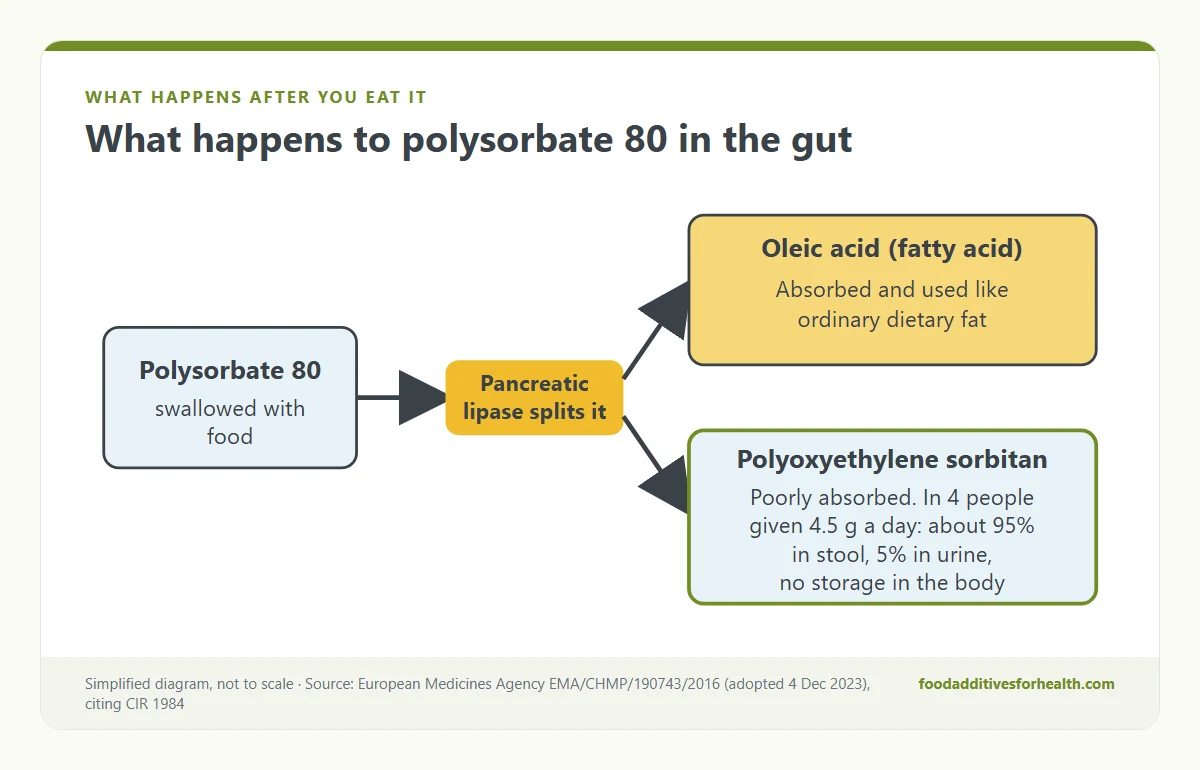
The EMA summarises it this way: after oral exposure, almost solely the released fatty acid becomes systemically available. Most of the molecule passes through rather than accumulating. Very high doses are a different matter: early high-dose studies showed diarrhoea attributed to large amounts of free polyol (sorbitol).
Where you find polysorbate 80
In the US, 21 CFR 172.840 lists permitted uses with maximums. Examples include:
- ice cream, frozen custard, ice milk, fruit sherbet and non-standardised frozen desserts, at 0.1%
- pickles and pickle products, at 500 ppm
- coarse crystal salt, at 10 ppm
- shortenings and edible oils, at 1%
In the EU, polysorbates are authorised as a group (E 432–436) “in a wide variety of foods at maximum levels ranging between 500 and 10 000 mg/kg and quantum satis in food supplements”, according to Regulation (EU) 2020/356. That regulation, adopted in 2020, also added a 10 mg/kg anti-foaming use in carbonated flavoured drinks, cider and perry, fruit wine and made wine, and other alcoholic drinks. Codex, the international food standards body, lists INS 433 in its group “Polysorbates”. The same emulsifier textbook says most dairy and bakery uses fall below 0.3%.
Outside food, polysorbates are common excipients in medicines. The EMA notes they are among the most common surfactants in biological medicinal products, and the FDA names polysorbate 80 in vaccines as an emulsifier that helps ingredients mix together and keep them from separating.
Is polysorbate 80 safe? Safety and regulation
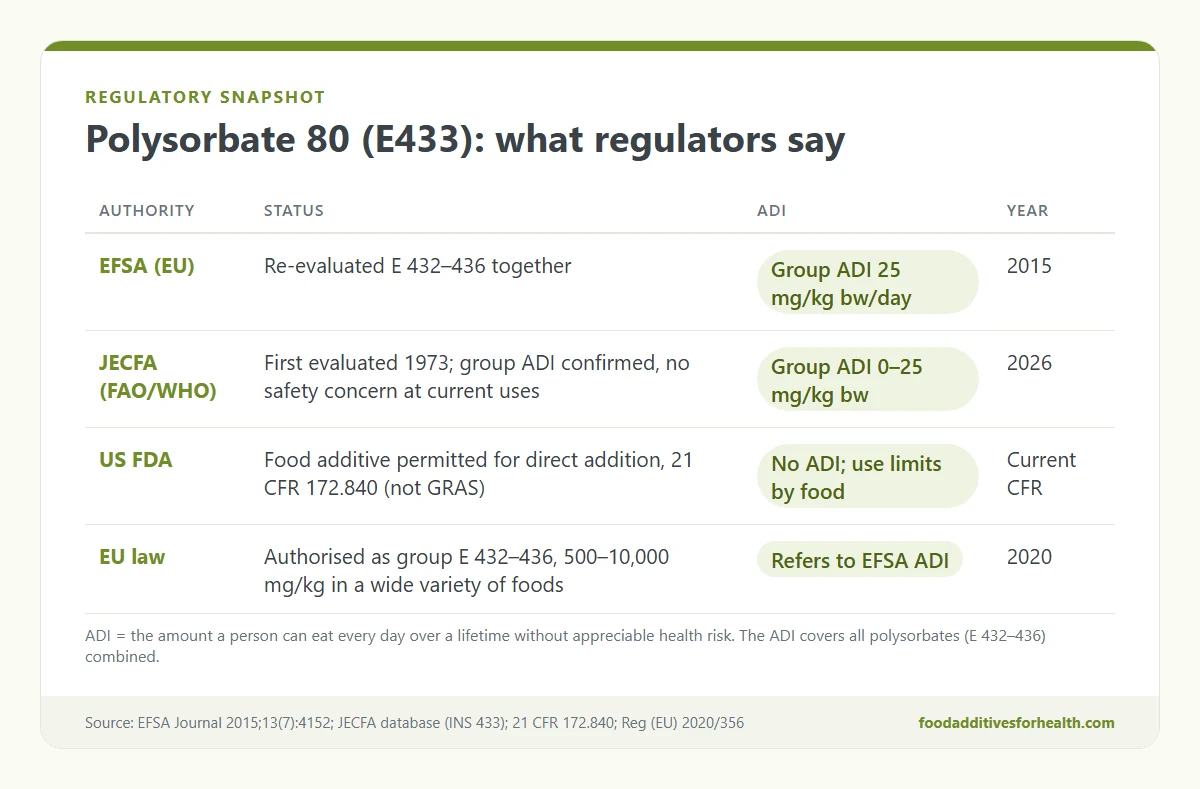
The regulatory picture is consistent. EFSA’s panel set a group ADI of 25 mg/kg bw/day for all five polysorbates in 2015, based on a no-observed-adverse-effect level of 2,500 mg/kg bw/day in a long-term study in rats, divided by a safety factor of 100. The key study was a two-year rat carcinogenicity study of polysorbate 80 itself. The ADI is the amount a person could eat every day for life without appreciable risk. The 100-fold factor builds in room for differences between rats and people, and between people.
EFSA found no concern regarding genotoxicity, carcinogenicity or developmental toxicity and, from a limited number of studies, no indication of reproductive toxicity. An earlier group ADI of 10 mg/kg bw/day from the EU’s former scientific committee in the 1980s was superseded by EFSA’s 2015 figure.
JECFA first evaluated it in 1973 and, in 2026, confirmed a group ADI of 0–25 mg/kg bw as total polyoxyethylene (20) sorbitan esters. It concluded that use at current Codex uses and maximum levels does not pose a safety concern. The FDA does not state an ADI; it regulates polysorbate 80 through the use limits in 21 CFR 172.840.
How close is real intake to the ADI?
As an illustration, 25 mg/kg multiplied by 60 kg is 1,500 mg a day for all polysorbates combined; for a 12 kg toddler it is 300 mg. Children are the group closest to the limit. In EFSA’s refined scenario, high-level exposure in toddlers was 24.5 mg/kg bw/day, very close to but not above the group ADI. That figure covers all polysorbates together, and EFSA said more usage and analytical data were needed. JECFA likewise reported that the highest estimated exposure, 24.5 mg/kg bw/day in European children aged 1–17, is within the upper bound of the group ADI. A high-end estimate is not a typical day, but it explains why regulators ask for better data.
Impurities
Ethylene oxide is used to make polysorbates, so a trace could remain. The IARC (the cancer research agency of the WHO) classes ethylene oxide as Group 1 and 1,4-dioxane as Group 2B, which describes hazard, not the risk at a given level. The EU specification caps 1,4-dioxane at 5 mg/kg of the additive, and under Regulation (EU) 2022/1396 ethylene oxide may not be used to sterilise food additives, and residues above 0.1 mg/kg are not allowed.
Who should take care?
Toddlers and children have the highest estimated exposure. For pregnancy, EFSA reported no concern for developmental toxicity. Allergy is covered in the FAQ below.
Myths vs facts
“It is GRAS, so nobody checks it.” The “GRAS” label is wrong for this additive. In the US it is a food additive permitted under 21 CFR 172.840. In the EU it is authorised and has a specification, and JECFA confirmed its ADI in 2026.
“It causes cancer.” EFSA found no concern for carcinogenicity, and its ADI rests on a two-year rat cancer study of polysorbate 80. A mouse study did report exacerbated tumour development, but in a chemically induced colitis-cancer model with 1.0% emulsifier in drinking water. That shows a hazard under specific lab conditions, not a risk at food levels.
“It breaks the blood-brain barrier.” The EMA describes enhanced drug uptake into the brain after intravenous dosing in mice (from 3.2 mg/kg) and rats (20 mg/kg), or when it coats drug nanoparticles. After eating it, the intact molecule’s bioavailability is described as “extremely low”, and none of the sorbitol label was found in rat brain.
“It is in vaccines, so it must be a problem to eat.” In vaccines it acts as an emulsifier. Injection and eating are different routes: the EMA’s allergy warning applies to injected products only, because after intravenous use the whole intact molecule enters the bloodstream.
“It is proven to wreck gut health.” The evidence here is genuinely mixed. In mice given 1.0% polysorbate 80 in drinking water for 12 weeks, researchers saw low-grade inflammation, metabolic syndrome and colitis in susceptible animals. A mouse behaviour study at 1% found anxiety-like changes in males in one test, while its authors called translating to humans “inherently difficult”. A mouse study at 180 mg/kg/day saw no physiology or inflammation differences versus control. Yet in a double-blind, placebo-controlled trial of 60 healthy adults given five emulsifiers including polysorbate 80, inflammation markers did not differ from placebo. That trial was short and exploratory. In its opinions on related emulsifiers, EFSA has said additional studies are needed to show the relevance of such mouse effects for human health, and scientists disagree on how far the mouse doses reflect real diets.
“It is a preservative.” No. JECFA classes it as an emulsifier, and EU labelling rules file it under that category.
How to spot polysorbate 80 on a label
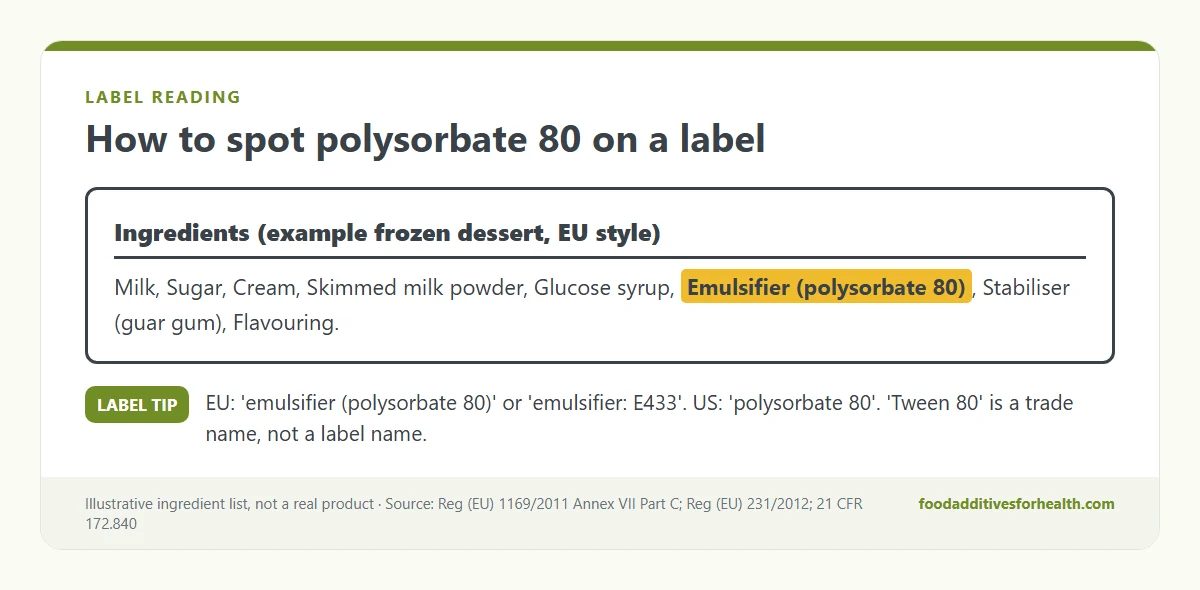
In the EU, an additive in the category “emulsifier” must be designated by the name of that category, followed by its specific name or, if appropriate, E number. So you might read “emulsifier (polysorbate 80)” or “emulsifier: E433”. The EU specification also recognises the names polyoxyethylene sorbitan monooleate and polyoxyethylene (20) sorbitan monooleate.
In the US, the name used in 21 CFR is “polysorbate 80”, and US ingredient lists do not use E-numbers. Internationally the code is INS 433. “Tween 80” is a trade name, so it is not what you should expect to see on a food label.
A label cannot tell you where the oleic acid comes from. The EU specification says only “edible commercial oleic acid” and does not specify the origin.
FAQ
Is polysorbate 80 safe to eat?
At the reported uses and use levels, regulators consider it safe. EFSA set a group ADI of 25 mg/kg bw/day in 2015, and JECFA confirmed 0–25 mg/kg bw in 2026, finding no safety concern at current uses. In the US, use is limited under 21 CFR 172.840.
Is polysorbate 80 bad for you?
Not at regulated levels, according to EFSA and JECFA. Warning signs come mostly from mice given 1% in drinking water, while a human trial found no inflammation change. The highest estimated child exposure is close to but within the ADI.
What is polysorbate 80 made from?
It is made from sorbitol and oleic acid (a fatty acid), which are then reacted with ethylene oxide, about 20 units per molecule. The US manufacturing description and the EU definition both follow this route. The result is a mixture, not one molecule.
Does polysorbate 80 affect the brain?
Not from food, as far as the regulators’ evidence shows. Brain-uptake effects are described after intravenous dosing or when it coats drug nanoparticles. Eaten, the intact molecule’s bioavailability is “extremely low”. A mouse behaviour study at 1% in water is not human evidence.
Is polysorbate 80 a preservative?
No. JECFA’s functional class for it is emulsifier, and under EU labelling rules it is declared under the emulsifier category. Its job is to keep oil and water mixed or to disperse flavours, not to stop spoilage.
Can you be allergic to polysorbate 80?
Rare reactions are reported, mainly with injected medicines. The EMA applies its allergy warning to injected products, and one case report described a non-immune anaphylactoid reaction to a medical product. A case series reported cross-reactivity with PEG. Ask your doctor if you have a diagnosed reaction.
Bottom line
Polysorbate 80 is an emulsifier with a long regulatory record. EFSA’s 2015 group ADI of 25 mg/kg bw/day was confirmed by JECFA in 2026, and in the US it is a regulated food additive, not a GRAS ingredient. Most of it passes through you; the fatty acid is digested like other fat. The mouse findings are worth following, but a short human trial did not show the same effect, and children’s high-end exposure sitting close to the ADI is why regulators want more data. Reading labels lets you decide for yourself.
References
- EFSA ANS Panel (2015). Scientific Opinion on the re-evaluation of polyoxyethylene sorbitan monolaurate (E 432), polyoxyethylene sorbitan monooleate (E 433), polyoxyethylene sorbitan monopalmitate (E 434), polyoxyethylene sorbitan monostearate (E 435) and polyoxyethylene sorbitan tristearate (E 436) as food additives. EFSA Journal 13(7):4152. https://doi.org/10.2903/j.efsa.2015.4152
- JECFA. Polyoxyethylene (20) sorbitan monooleate (INS 433), evaluations 1973 and 2026. WHO JECFA database. https://apps.who.int/food-additives-contaminants-jecfa-database/Home/Chemical/2507
- WHO (1974). Toxicological evaluation of some food additives: polyoxyethylene (20) sorbitan esters. WHO Food Additives Series 5. https://inchem.org/documents/jecfa/jecmono/v05je47.htm
- US eCFR. 21 CFR 172.840 Polysorbate 80. https://www.ecfr.gov/current/title-21/chapter-I/subchapter-B/part-172/subpart-I/section-172.840
- US eCFR. 21 CFR Part 172 Subpart I, Multipurpose additives. https://www.ecfr.gov/current/title-21/chapter-I/subchapter-B/part-172/subpart-I
- Commission Regulation (EU) No 231/2012, specifications, E 433 (OJ L 83, 22.3.2012, p. 160). https://eur-lex.europa.eu/LexUriServ/LexUriServ.do?uri=OJ:L:2012:083:0001:0295:EN:PDF
- Commission Regulation (EU) 2022/1396 (ethylene oxide in food additives). https://eur-lex.europa.eu/eli/reg/2022/1396/oj/eng
- Commission Regulation (EU) 2020/356 (polysorbates in certain drinks). https://eur-lex.europa.eu/eli/reg/2020/356/oj/eng
- Regulation (EU) No 1169/2011 on the provision of food information to consumers, Annex VII Part C. https://eur-lex.europa.eu/legal-content/EN/TXT/HTML/?uri=CELEX:32011R1169
- Codex Alimentarius. GSFA food additives list (Polysorbates, INS 432–436). https://codex.fao.org/codex-texts/codex-online-databases/gsfa/food-additives-list
- European Medicines Agency (2024). Information for the package leaflet regarding polysorbates used as excipients in medicinal products for human use. EMA/CHMP/190743/2016 (adopted 4 Dec 2023). https://www.ema.europa.eu/en/documents/scientific-guideline/information-package-leaflet-regarding-polysorbates-used-excipients-medicinal-products-human-use_en.pdf
- US FDA. Common Ingredients in FDA-Approved Vaccines (content current as of 03/02/2026). https://www.fda.gov/vaccines-blood-biologics/safety-availability-biologics/common-ingredients-fda-approved-vaccines
- IARC Monographs. List of Classifications (ethylene oxide Group 1; 1,4-dioxane Group 2B). https://monographs.iarc.who.int/wp-content/uploads/2019/02/List_of_Classifications.pdf
- Chassaing B, et al. (2015). Dietary emulsifiers impact the mouse gut microbiota promoting colitis and metabolic syndrome. Nature 519:92–96. https://doi.org/10.1038/nature14232
- Wellens J, et al. (2026; online 2025). Effect of five dietary emulsifiers on inflammation, permeability, and the gut microbiome: a placebo-controlled randomized trial. Clin Gastroenterol Hepatol 24(4):1092–1101. https://doi.org/10.1016/j.cgh.2025.08.005
- Bravo-Núñez Á, et al. (2025). Commun Biol 8:896. https://doi.org/10.1038/s42003-025-08293-4
- Holder MK, et al. (2019). Dietary emulsifiers consumption alters anxiety-like and social-related behaviors in mice in a sex-dependent manner. Sci Rep 9:172. https://doi.org/10.1038/s41598-018-36890-3
- Viennois E, Merlin D, Gewirtz AT, Chassaing B (2017). Dietary emulsifier-induced low-grade inflammation promotes colon carcinogenesis. Cancer Res 77(1):27–40. https://doi.org/10.1158/0008-5472.CAN-16-1359
- Coors EA, Seybold H, Merk HF, Mahler V (2005). Polysorbate 80 in medical products and nonimmunologic anaphylactoid reactions. Ann Allergy Asthma Immunol 95(6):593–599. https://doi.org/10.1016/S1081-1206(10)61024-1
- Stone CA, et al. (2019). Immediate hypersensitivity to polyethylene glycols and polysorbates: more common than we have recognized. J Allergy Clin Immunol Pract 7(5):1533–1540. https://pmc.ncbi.nlm.nih.gov/articles/PMC6706272
- Norn V (ed.) (2015). Emulsifiers in Food Technology, 2nd ed. Wiley-Blackwell.

This work has an elegant simplicity to it, yet it holds layers of depth beneath the surface.
Nice